
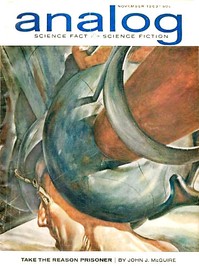
Take the Reason Prisoner
Written by John J. (John Joseph) McGuire
Chaptra reads alongside you — AI insights, chapter breakdowns and reader discussions for every book. Join free
About this book
Reading guide
Themes, characters and key ideas in Take the Reason Prisoner, written by Chaptra AI.
- about 8 hours
- intermediate
- dark
- thought-provoking
- dystopian
John J. McGuire's "Take the Reason Prisoner" is an early 1960s science fiction novel set in a futuristic prison, Duncannon Processing Prison, grappling with the ethics of criminal justice and psychological manipulation. Major General James J. Bennington arrives as the new warden, immediately confronted by political interests and the unsettling methods of Dr. Thornberry, the chief psychologist. As Bennington navigates the complex system, he uncovers profound moral dilemmas concerning the psychological conditioning used on inmates, questioning its efficacy and humanity. The narrative delves into his struggle to reconcile his duty with his conscience, exposing the dark underbelly of a system designed to 'rehabilitate' but potentially stripping individuals of their free will. Ultimately, the novel serves as a critical examination of power, control, and the definition of justice in a technologically advanced society.
“"A prison is meant to hold men, Bennington, not to break their very will to be men."”
Key themes
- Criminal Justice and Rehabilitation
- The core theme explores the fundamental purpose and ethics of a criminal justice system. It questions whether punishment should focus on retribution, deterrence, or genuine rehabilitation, particularly when the latter involves psychological manipulation. The novel critiques a system that prioritizes societal order and control over the individual's inherent rights and mental integrity.
- Psychological Manipulation and Free Will
- This theme delves into the ethical implications of using advanced psychology to alter human behavior, thoughts, and personality. It examines the concept of free will in the face of scientific conditioning, asking if a 'rehabilitated' individual who has lost their autonomy is truly free or merely a controlled entity. The novel highlights the dangerous slippery slope when science is used to dictate morality.
- Morality and Ethics in Power
- The novel critically examines how power, particularly institutional power, can corrupt or be misused, leading to morally questionable practices. Bennington's struggle highlights the individual's ethical responsibility when placed in a position of authority over others. It questions whether noble intentions can justify unethical means, and the ease with which systems can prioritize efficiency and control over human dignity.
Worth discussing
To what extent is psychological conditioning a legitimate form of rehabilitation, and where should ethical lines be drawn?
Chapter-by-chapter breakdowns, character arcs and the full thematic analysis come with a free account.
Discussions
No one has started one yet
Questions this book opens up
No discussions yet
Be the first to start a discussion about this book!
Sign up to start the discussionReviews
No reviews yet
Be the first to review this book!