
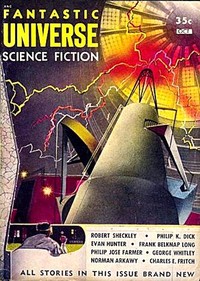
Strangers to Straba
Written by Carl Jacobi
Chaptra reads alongside you — AI insights, chapter breakdowns and reader discussions for every book. Join free
About this book
Reading guide
Themes, characters and key ideas in Strangers to Straba, written by Chaptra AI.
- about 8 hours
- intermediate
- dark
- mysterious
- haunting
Carl Jacobi's "Strangers to Straba," an early 1950s science fiction novel, plunges readers into the desolate world of Straba, where the only inhabitant, Cap Barlow, encounters young botanist Clarence Raine. Raine's scientific curiosity quickly morphs into an obsession when he discovers the derelict spaceship "Perseus," a relic tied to the ominous tales of another vessel, the "Andromeda," and the life-draining entities known as Absorbers. As Raine meticulously salvages the "Perseus," he unwittingly reanimates its dormant consciousness, leading to a chilling climax where the ship, driven by ancient emotions, seeks a fateful reunion with the "Andromeda." The novel masterfully blends adventure with cosmic horror, serving as a cautionary tale about unchecked ambition and the profound consequences of disturbing forgotten terrors.
“On Straba, silence was not merely the absence of sound, but a presence, vast and ancient, that pressed down upon the soul.”
Key themes
- The Dangers of Unchecked Curiosity and Ambition
- Central to the novel, this theme explores how humanity's drive for discovery and ambition, when unchecked by caution or ethics, can lead to catastrophic consequences. Raine's transformation from researcher to obsessive salvager exemplifies this dangerous pursuit.
- Isolation and Desolation
- The novel uses the desolate planet Straba and Cap Barlow's solitary existence to explore the psychological impact of extreme isolation. This theme highlights humanity's vulnerability when faced with vast, indifferent emptiness, and how it can warp perception or amplify obsessions.
- Cosmic Horror and the Unknown
- Jacobi masterfully integrates elements of cosmic horror, where humanity is confronted with terrifying, incomprehensible entities and forces beyond its control. The mysterious Absorbers and the sentient 'Perseus' evoke a sense of insignificance and dread in the face of an indifferent, often malevolent, universe.
Worth discussing
How does the desolate setting of Straba contribute to the novel's overall atmosphere and themes?
Chapter-by-chapter breakdowns, character arcs and the full thematic analysis come with a free account.
Discussions
No one has started one yet
Questions this book opens up
No discussions yet
Be the first to start a discussion about this book!
Sign up to start the discussionReviews
No reviews yet
Be the first to review this book!