
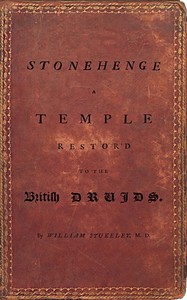
Stonehenge, a Temple Restor'd to the British Druids
Written by William Stukeley
Chaptra reads alongside you — AI insights, chapter breakdowns and reader discussions for every book. Join free
About this book
Reading guide
Themes, characters and key ideas in Stonehenge, a Temple Restor'd to the British Druids, written by Chaptra AI.
- about 10 hours
- advanced
- Investigative
- Reverential
- Scholarly
William Stukeley's "Stonehenge, a Temple Restor'd to the British Druids" is an early 18th-century antiquarian work that meticulously describes and interprets the famous megalithic monument. Stukeley, a pioneering archaeologist, posits that Stonehenge was constructed by the ancient British Druids as a sophisticated temple reflecting a pure, patriarchal religion. The book details his systematic fieldwork, including precise measurements and architectural analyses, to support his thesis that these ancient structures are vital to understanding Britain's spiritual and historical lineage. Through his blend of empirical observation and speculative historical reconstruction, Stukeley aimed to preserve the memory of these wonders and firmly establish the Druids as their master builders. It serves as a foundational text in both British archaeology and the romanticized image of the Druids.
“I have spent many summers in the study and contemplation of these mighty works of the Druids, and have measured them with the greatest exactness.”
Key themes
- Antiquarianism and the Birth of Archaeology
- The book serves as a prime example of 18th-century antiquarianism, which blended meticulous observation with historical speculation. Stukeley's systematic fieldwork, detailed measurements, and illustrative drawings represent a significant step towards modern archaeological methods, even while his interpretations remain firmly rooted in the intellectual context of his time.
- The Search for National Origins and Identity
- Stukeley's work reflects a broader 18th-century European trend of seeking ancient, prestigious origins for national identity. By connecting Stonehenge to the Druids, and the Druids to a pure, patriarchal religion, he aimed to provide Britain with a glorious, indigenous past that predated Roman conquest and aligned with Christian narratives, thereby bolstering a sense of national pride and historical depth.
- Religion and Antiquity
- Stukeley, an Anglican clergyman, deeply imbued his archaeological interpretations with religious purpose. He sought to reconcile the perceived paganism of ancient Britain with a monotheistic worldview, arguing that Druidism was a pure, uncorrupted form of Abrahamic religion. This reflects a common Enlightenment effort to rationalize and integrate ancient history within a providential Christian framework.
Worth discussing
How does Stukeley's work exemplify the transition from antiquarianism to modern archaeology? What are the key differences and continuities?
Chapter-by-chapter breakdowns, character arcs and the full thematic analysis come with a free account.
Discussions
No one has started one yet
Questions this book opens up
No discussions yet
Be the first to start a discussion about this book!
Sign up to start the discussionReviews
No reviews yet
Be the first to review this book!