
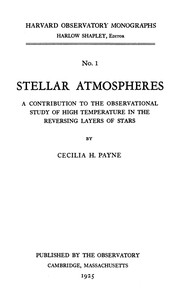
Stellar atmospheres : $b A contribution to the observational study of high temperature in the reversing layers of stars
Written by Cecilia Payne-Gaposchkin
Chaptra reads alongside you — AI insights, chapter breakdowns and reader discussions for every book. Join free
About this book
This work by Payne-Gaposchkin, Cecilia offers readers a unique literary experience. The narrative explores themes of thesis (ph. d.) and stars.
Read it with a club
Small groups reading the same books and talking as they go.


News
- 4 members
- 1,813 discussions
- Active Sep 11
Read Stellar atmospheres : $b A contribution to the observational study of high temperature in the reversing layers of stars alongside people who are reading it too.
Also here: News Bulletin, Just Joking....
Chaptra Prime — paid clubs, every club feature, and unlimited reading support, for $5 a month or $60 once.
See PrimeReading guide
Themes, characters and key ideas in Stellar atmospheres : $b A contribution to the observational study of high temperature in the reversing layers of stars, written by Chaptra AI.
- about 30 hours
- advanced
- analytical
- groundbreaking
- rigorous
Cecilia Payne-Gaposchkin's "Stellar Atmospheres" is a groundbreaking scientific monograph that laid the foundation for modern astrophysics by determining the chemical composition of stars, most notably the overwhelming abundance of hydrogen and helium. Published in 1925 as her doctoral dissertation, it meticulously analyzes stellar spectra to deduce the physical conditions and elemental abundances in stellar atmospheres, challenging prevailing scientific thought that stars had a similar composition to Earth. Her rigorous application of quantum mechanics and Saha's ionization equation revolutionized the understanding of stellar interiors and spectra, establishing a new paradigm in astronomy. The work's profound conclusions were initially met with skepticism but were eventually recognized as one of the most significant discoveries in 20th-century astrophysics.
“The physical conditions in the reversing layers of the stars are treated primarily from the theoretical standpoint.”
Key themes
- The Chemical Composition of Stars
- This is the central scientific theme of the book. Payne-Gaposchkin rigorously demonstrates that stars are primarily composed of hydrogen and helium, challenging the long-held belief that their composition mirrored Earth's. This theme is explored through detailed spectral analysis and the application of ionization theory.
- The Role of Temperature in Stellar Spectra
- Payne-Gaposchkin meticulously shows that the apparent variations in elemental strength across different stellar spectral types are primarily due to temperature differences affecting the ionization and excitation states of atoms, rather than actual differences in elemental abundance. This was a crucial insight that allowed for the correct interpretation of stellar spectra.
- The Synthesis of Observation and Theory
- The book exemplifies the power of combining precise astronomical observations (stellar spectra) with advanced theoretical physics (quantum mechanics and statistical mechanics, specifically Saha's ionization theory). Payne-Gaposchkin's work demonstrates that neither approach alone could have yielded such profound insights, highlighting the synergy between empirical data and theoretical models in scientific discovery.
Worth discussing
How did Payne-Gaposchkin's use of quantum mechanics and Saha's ionization equation revolutionize the study of stellar atmospheres?
Chapter-by-chapter breakdowns, character arcs and the full thematic analysis come with a free account.
Discussions
No one has started one yet
Questions this book opens up
No discussions yet
Be the first to start a discussion about this book!
Sign up to start the discussionReviews
No reviews yet
Be the first to review this book!