
About this book
Read it with a club
Small groups reading the same books and talking as they go.


News
- 4 members
- 1,813 discussions
- Active Sep 11
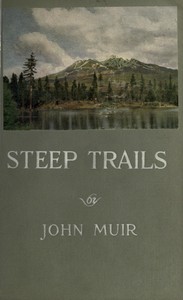
Read Steep Trails alongside people who are reading it too.
Also here: News Bulletin, Just Joking....
Chaptra Prime — paid clubs, every club feature, and unlimited reading support, for $5 a month or $60 once.
See PrimeReading guide
Themes, characters and key ideas in Steep Trails, written by Chaptra AI.
- about 8 hours
- intermediate
- Awe-inspiring
- Reflective
- Adventurous
John Muir's "Steep Trails" is a seminal collection of essays chronicling his profound personal experiences and meticulous observations of the American West's untamed landscapes, including California, Utah, Nevada, and the Grand Canyon. Written in the late 19th century, the work serves as a powerful testament to Muir's deep reverence for the wilderness, contrasting its inherent beauty and utility with humanity's tendency towards cultivation and exploitation. Through vivid descriptions and philosophical reflections, Muir champions the intrinsic value of nature, arguing that its creations exist for their own purposes, not solely for human benefit. The collection establishes Muir's enduring legacy as a pioneering voice in the conservation movement, inspiring generations to appreciate and protect wild places.
“"When we try to pick out anything by itself, we find it hitched to everything else in the universe."”
Key themes
- The Intrinsic Value of Wilderness
- This is the core philosophical tenet of Muir's work. He argues that nature, in its wild and untamed state, possesses inherent worth and beauty independent of human utility or appreciation. The wilderness is not merely a resource to be exploited but a self-sufficient entity deserving of respect and preservation for its own sake. He illustrates this through the example of wild sheep, whose superior wool exists for the sheep themselves, not for human gain.
- Humanity's Relationship with Nature
- Muir critically examines how humans interact with the natural world, often contrasting destructive exploitation with respectful coexistence. He laments humanity's tendency to 'cultivate' and 'improve' nature, seeing it as an imposition that diminishes true beauty and utility. He advocates for a relationship built on reverence, observation, and preservation, rather than conquest or commodification.
- The Spiritual and Regenerative Power of Wilderness
- For Muir, wilderness is not just a physical place but a profound source of spiritual renewal, mental clarity, and moral instruction. He often describes his experiences in nature in terms of religious awe and transcendence, suggesting that immersion in the wild can heal the human spirit from the corrupting influences of civilization. This theme highlights nature as a sacred space where one can connect with a higher power or universal truths.
Worth discussing
How does Muir's concept of 'wildness' contrast with human 'cultivation,' and what are the implications of this distinction for modern society?
Chapter-by-chapter breakdowns, character arcs and the full thematic analysis come with a free account.
Discussions
No one has started one yet
Questions this book opens up
No discussions yet
Be the first to start a discussion about this book!
Sign up to start the discussionReviews
No reviews yet
Be the first to review this book!