
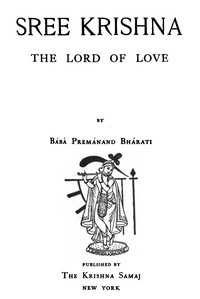
Sree Krishna, the Lord of Love
Written by Baba Premananda Bharati
Chaptra reads alongside you — AI insights, chapter breakdowns and reader discussions for every book. Join free
About this book
Reading guide
Themes, characters and key ideas in Sree Krishna, the Lord of Love, written by Chaptra AI.
- about 12 hours
- advanced
- philosophical
- spiritual
- enlightening
Baba Premananda Bharati's "Sree Krishna, the Lord of Love" is an early 20th-century philosophical treatise exploring Hindu spirituality through the lens of Lord Krishna. The work meticulously outlines profound concepts such as the cyclical nature of existence, the process of creation and dissolution, and humanity's inherent spiritual essence. At its core, the book posits that the universal quest for eternal happiness culminates in understanding and experiencing divine love, supremely embodied by Krishna. Bharati guides readers on an intellectual and spiritual journey, urging them to transcend physical limitations and realize their true selves through spiritual awakening and an internal pursuit of joy.
“The universe's creation, humanity's spiritual essence, and the eternal quest for happiness ultimately lead back to Krishna, the embodiment of love.”
Key themes
- Divine Love (Krishna)
- This is the central, overarching theme. The book posits that Lord Krishna is the supreme embodiment of divine, unconditional love, and that understanding and experiencing this love is the ultimate goal of human existence and the source of eternal happiness. It explores how this divine love permeates creation and offers a path to spiritual fulfillment.
- Cyclical Nature of Existence
- The book delves into Hindu cosmology, emphasizing the cyclical processes of creation, preservation, and dissolution (Samsara, Yugas). This theme highlights that existence is not linear but an eternal, repeating cycle, influencing understanding of time, destiny, and the impermanence of physical forms.
- Spiritual Awakening and Self-Realization
- A core tenet of the book is the necessity of spiritual awakening to realize one's true self beyond the physical body. This involves a shift in consciousness, moving from material identification to an awareness of one's eternal, spiritual essence. It's presented as the path to transcending suffering and achieving lasting happiness.
Worth discussing
How does the book define 'eternal happiness' and how does it compare to modern understandings of joy or contentment?
Chapter-by-chapter breakdowns, character arcs and the full thematic analysis come with a free account.
Discussions
No one has started one yet
Questions this book opens up
No discussions yet
Be the first to start a discussion about this book!
Sign up to start the discussionReviews
No reviews yet
Be the first to review this book!