
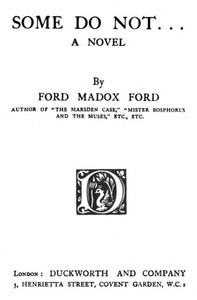
Some do not...: A novel
Written by Ford Madox Ford
Chaptra reads alongside you — AI insights, chapter breakdowns and reader discussions for every book. Join free
About this book
Reading guide
Themes, characters and key ideas in Some do not...: A novel, written by Chaptra AI.
- about 10 hours
- advanced
- melancholic
- introspective
- critical
Ford Madox Ford's "Some Do Not..." is the inaugural novel in the *Parade's End* tetralogy, introducing Christopher Tietjens, an anachronistic embodiment of Edwardian integrity and duty, navigating a rapidly changing pre-World War I England. The narrative intricately explores his tumultuous marriage to the capricious Sylvia, who uses his unwavering honor against him, and his burgeoning, chaste affection for the progressive suffragette, Valentine Wannop. Set against a backdrop of societal decay, moral ambiguity, and the impending Great War, the novel delves into themes of honor, duty, love, and the collapse of the old order. Tietjens' stoic endurance of personal and public scandal serves as a poignant commentary on a world losing its moral compass.
“The world was going to the dogs, but the dogs were gentlemen.”
Key themes
- The Decline of the Edwardian/Victorian Order
- The novel vividly portrays the disintegration of the traditional English social structure, moral codes, and class system preceding World War I. Tietjens embodies the last vestiges of this dying world, his principles clashing with the emerging cynicism, materialism, and moral relativism of modern society.
- Duty vs. Desire
- This central theme explores Christopher Tietjens' internal conflict between his deeply ingrained sense of duty and honor (to his wife, his family, and his principles) and his personal desires for happiness, love, and emotional fulfillment. His commitment to duty often leads to profound personal suffering.
- Marriage and Morality
- The novel meticulously dissects the institution of marriage in early 20th-century England, particularly through the lens of Christopher and Sylvia's dysfunctional relationship. It explores infidelity, societal expectations for marital conduct, the double standards applied to men and women, and the psychological warfare that can occur within a marriage.
Worth discussing
How does Christopher Tietjens embody or challenge the traditional ideals of an 'English gentleman' in the early 20th century?
Chapter-by-chapter breakdowns, character arcs and the full thematic analysis come with a free account.
Discussions
No one has started one yet
Questions this book opens up
No discussions yet
Be the first to start a discussion about this book!
Sign up to start the discussionReviews
No reviews yet
Be the first to review this book!