
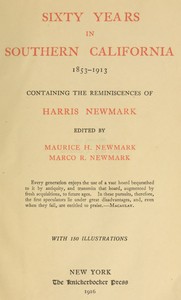
Sixty Years in Southern California, 1853-1913: Containing the Reminiscences of Harris Newmark
Written by Harris Newmark
Chaptra reads alongside you — AI insights, chapter breakdowns and reader discussions for every book. Join free
About this book
Reading guide
Themes, characters and key ideas in Sixty Years in Southern California, 1853-1913: Containing the Reminiscences of Harris Newmark, written by Chaptra AI.
- about 20 hours
- intermediate
- historical
- informative
- reflective
Harris Newmark's "Sixty Years in Southern California, 1853-1913" is an invaluable historical memoir chronicling his extensive life and observations in Los Angeles and the broader Southern California region. Spanning six decades, the book offers a first-hand account of the area's dramatic transformation from a nascent frontier to a burgeoning modern society. Newmark interweaves personal experiences, detailed historical events, and insights into the lives of key figures, providing a rich tapestry of the social, economic, and cultural developments of the era. Beginning with his challenging journey as an immigrant from Prussia, the narrative establishes a foundation for understanding the profound changes he witnessed and helped shape. It serves as both a personal testament and a primary historical document, capturing the essence of a pivotal period in California's history.
“Coming to California in '53 was like stepping into another world, a land of promise and raw challenge.”
Key themes
- Urbanization and Frontier Development
- A primary focus of the memoir is the dramatic transformation of Southern California, particularly Los Angeles, from a sparsely populated frontier territory into a thriving urban center. Newmark meticulously documents the various stages of this development: the establishment of infrastructure, the growth of key industries (agriculture, real estate, oil, transportation), the influx of population, and the evolution of civic institutions. It’s a firsthand account of how a wilderness was tamed and built into a modern society.
- Immigration and the American Dream
- The book profoundly explores the immigrant experience, beginning with Newmark's own journey from Prussia. It details the motivations for leaving one's homeland, the challenges of travel and assimilation, and the pursuit of opportunity in a new land. This theme is central to understanding the rapid population growth and cultural diversity of Southern California, as Newmark's story mirrors that of countless others who sought a better life in the American West.
- Memory and Historical Preservation
- The very act of writing this memoir underscores the theme of memory and the importance of preserving history. Newmark, writing in his later years, consciously attempts to document a period of immense change that he lived through, recognizing that much of that history would otherwise be lost. The book serves as a personal act of remembrance, but also a public service to future generations, highlighting the subjective yet invaluable nature of eyewitness accounts.
Worth discussing
How does Newmark's personal journey as an immigrant shape his observations of Southern California's development?
Chapter-by-chapter breakdowns, character arcs and the full thematic analysis come with a free account.
Discussions
No one has started one yet
Questions this book opens up
No discussions yet
Be the first to start a discussion about this book!
Sign up to start the discussionReviews
No reviews yet
Be the first to review this book!