
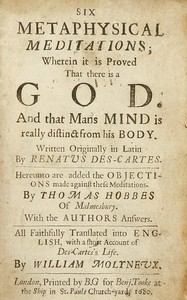
Six metaphysical meditations: $b Wherein it is proved that there is a God and that mans mind is really distinct from his body
Written by René Descartes
Chaptra reads alongside you — AI insights, chapter breakdowns and reader discussions for every book. Join free
About this book
Reading guide
Themes, characters and key ideas in Six metaphysical meditations: $b Wherein it is proved that there is a God and that mans mind is really distinct from his body, written by Chaptra AI.
- about 15 hours
- advanced
- philosophical
- rigorous
- introspective
René Descartes's "Six Metaphysical Meditations" is a foundational philosophical treatise that meticulously reconstructs knowledge from a state of radical doubt. Through a series of six meditations, Descartes systematically dismantles all previously held beliefs, questioning the reliability of sensory experience and even the existence of the external world. He famously arrives at the indubitable truth of his own existence as a thinking being (the 'Cogito'), which serves as the bedrock for all subsequent knowledge. The work then proceeds to offer rigorous proofs for the existence of God as a benevolent and non-deceiving creator, ultimately establishing the essential distinction between mind and body and affirming the reality of the material world. This rationalistic approach not only sought to provide a secure foundation for science but also profoundly shaped Western philosophy's understanding of self, knowledge, and reality.
“I saw that I could conceive that I had no body, and that there was no world, or any place in which I might be; but yet that I could not for all that conceive that I was not.”
Key themes
- Skepticism and Certainty
- This is the overarching theme of the Meditations. Descartes begins by employing radical skepticism, doubting sensory experience, the external world, and even mathematical truths through the 'evil demon' hypothesis. This methodical doubt is not an end in itself but a means to arrive at indubitable certainty, which he finds in the 'Cogito' and later in truths guaranteed by a non-deceiving God. The journey from extreme doubt to secure knowledge is the central intellectual drama.
- Epistemology and Rationalism
- The Meditations is fundamentally a work of epistemology, concerned with the nature and limits of human knowledge. Descartes champions a rationalistic approach, asserting that true knowledge is derived not from sensory experience (which is often misleading) but from clear and distinct ideas grasped by the intellect. He seeks to establish a firm foundation for knowledge, independent of empirical observation, through rigorous deduction and innate ideas.
- Mind-Body Dualism
- Descartes establishes a fundamental distinction between the mind (a thinking, non-extended substance) and the body (an extended, non-thinking substance). He argues that these two substances are entirely separate and distinct in their essences, even though they interact within a human being. This dualism has been immensely influential and controversial, shaping discussions about consciousness, identity, and the nature of reality.
Worth discussing
Is Descartes's method of radical doubt truly effective in establishing certainty, or does it lead to an unsolvable skepticism?
Chapter-by-chapter breakdowns, character arcs and the full thematic analysis come with a free account.
Discussions
No one has started one yet
Questions this book opens up
No discussions yet
Be the first to start a discussion about this book!
Sign up to start the discussionReviews
No reviews yet
Be the first to review this book!