
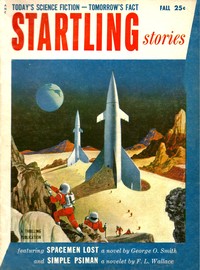
Simple psiman
Written by F. L. (Floyd L.) Wallace
Chaptra reads alongside you — AI insights, chapter breakdowns and reader discussions for every book. Join free
About this book
Reading guide
Themes, characters and key ideas in Simple psiman, written by Chaptra AI.
- about 8 hours
- intermediate
- mysterious
- adventurous
- thought-provoking
F. L. Wallace's "Simple psiman" is a mid-20th century science fiction novella set in a futuristic India, following Egan Rains, a telepathic astronomer known as a psiman. Rains embarks on a perilous quest to prevent a catastrophic comet collision with Earth, requiring him to locate a powerful teleport. His journey is fraught with challenges, including navigating a society rich in mentalists and mystics, confronting his own scientific rationalism against spiritual beliefs, and evading local scrutiny. Teaming up with Gowru Chandit, a skilled dyeman, Rains confronts both human and cosmic threats, leading to a thrilling exploration of telepathy, the clash between science and mysticism, and humanity's place in the vast universe.
“The universe cares nothing for our instruments, only for our will to survive.”
Key themes
- Telepathy and Psychic Abilities
- This theme explores the nature, implications, and societal integration of telepathy, teleportation, and other psychic powers. It delves into how these abilities shape individuals, influence power structures, and blur the lines between science and spirituality in a futuristic society.
- Science vs. Spirituality/Mysticism
- A central conflict of the story, this theme examines the tension and eventual reconciliation between empirical scientific understanding and mystical or spiritual beliefs. It questions whether these two approaches to knowledge are mutually exclusive or can coexist and even complement each other.
- Humanity's Place in the Universe/Cosmic Threat
- This theme explores humanity's vulnerability and resilience when confronted with existential threats from the vastness of space. It prompts reflection on our collective responsibility, our capacity for survival, and the scale of our existence within the cosmos.
Worth discussing
How does Wallace portray the clash between scientific rationalism and spiritual/mystical beliefs in the novella? Is one ultimately favored over the other?
Chapter-by-chapter breakdowns, character arcs and the full thematic analysis come with a free account.
Discussions
No one has started one yet
Questions this book opens up
No discussions yet
Be the first to start a discussion about this book!
Sign up to start the discussionReviews
No reviews yet
Be the first to review this book!