
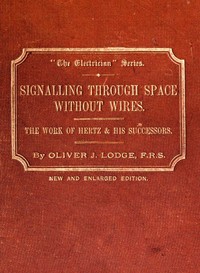
Signalling across space without wires: being a description of the work of Hertz & his successors
Written by Oliver Lodge
Chaptra reads alongside you — AI insights, chapter breakdowns and reader discussions for every book. Join free
About this book
Reading guide
Themes, characters and key ideas in Signalling across space without wires: being a description of the work of Hertz & his successors, written by Chaptra AI.
- about 12 hours
- advanced
- Informative
- Pioneering
- Technical
Sir Oliver Lodge's "Signalling across space without wires" is a pivotal late 19th-century scientific work detailing the pioneering experiments of Heinrich Hertz and their profound implications for wireless communication. The book elucidates the theoretical and practical aspects of transmitting electrical signals without physical connections, building upon Hertz's validation of Maxwell's electromagnetic theories. Lodge, through the lens of his Royal Institution lectures, not only demonstrates Hertz's groundbreaking work but also provides a foundational understanding of electromagnetic waves and their potential for revolutionary telegraphy. It serves as both a tribute to Hertz's genius and a foundational text for the emerging field of radio communication, bridging theoretical physics with practical applications.
“Hertz's work has given us an insight into the processes of nature which is of the profoundest interest.”
Key themes
- Scientific Discovery and Validation
- This is the central theme, exploring the process by which scientific theories (Maxwell's electromagnetism) are rigorously tested and confirmed through experimentation (Hertz's work). Lodge meticulously details the experimental setups and observations that provided empirical proof for the existence and properties of electromagnetic waves, emphasizing the crucial interplay between theoretical prediction and experimental verification in advancing scientific knowledge.
- Technological Innovation and Application
- The book not only describes fundamental scientific discoveries but also explicitly explores their immediate and future practical applications, particularly for wireless communication. Lodge demonstrates how abstract scientific principles can be harnessed to create revolutionary technologies, bridging the gap between pure science and engineering, and foreseeing the immense societal impact of these innovations.
- The Legacy of Genius and Scientific Succession
- Lodge's work is steeped in reverence for Heinrich Hertz, acknowledging his pivotal role and lamenting his early death. This theme explores how scientific progress is built upon the contributions of past giants, and how one generation of scientists interprets, expands upon, and honors the work of their predecessors. It highlights the intellectual lineage and the communal aspect of scientific endeavor.
Worth discussing
How did Hertz's experimental validation of Maxwell's theory fundamentally alter scientific understanding of electromagnetism and light?
Chapter-by-chapter breakdowns, character arcs and the full thematic analysis come with a free account.
Discussions
No one has started one yet
Questions this book opens up
No discussions yet
Be the first to start a discussion about this book!
Sign up to start the discussionReviews
No reviews yet
Be the first to review this book!