
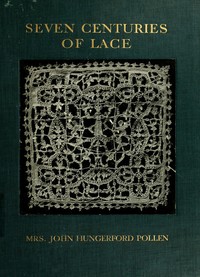
Seven Centuries of Lace
Written by Maria Margaret Pollen
Chaptra reads alongside you — AI insights, chapter breakdowns and reader discussions for every book. Join free
About this book
Reading guide
Themes, characters and key ideas in Seven Centuries of Lace, written by Chaptra AI.
- about 15 hours
- advanced
- Informative
- Historical
- Detailed
Maria Margaret Pollen's "Seven Centuries of Lace" is a foundational early 20th-century scholarly work that meticulously documents the historical, technical, and artistic evolution of lace-making. Through extensive research and full-sized photographic reproductions of her personal collection, Pollen traces the development of both needlepoint and bobbin lace from ancient Coptic origins through the early modern period. The book serves as an invaluable resource for enthusiasts and scholars, aiming to provide a comprehensive understanding of lace design, techniques, and its profound cultural significance across religious and secular contexts. It stands as a testament to the intricate artistry of lace and the importance of its preservation and detailed study.
“The difficulty of adequately illustrating lace, so as to convey a just idea of its intricate details, has often been a source of vexation.”
Key themes
- The Evolution of Art and Craft
- This theme explores how lace-making, from its earliest forms to the early 20th century, developed as both a craft and an art form. Pollen meticulously traces changes in design, technique, and aesthetic principles, demonstrating how lace reflected broader artistic movements and societal tastes. It highlights the ingenuity and skill involved in adapting materials and methods over centuries.
- Cultural and Social Significance of Textiles
- Pollen delves into the multifaceted role of lace in society, showing its importance beyond mere decoration. Lace served as a significant status symbol, indicating wealth and social standing, and played a crucial role in religious ceremonies, adorning vestments and altar cloths. It also had economic implications, supporting entire industries and communities.
- The Imperative of Preservation and Documentation
- A driving force behind Pollen's work is the urgent need to preserve and document historical lace, both physically (through her collection) and intellectually (through her detailed analysis and photography). She highlights the fragility of lace and the risk of losing knowledge about its creation and context, making the act of scholarly documentation a vital contribution to cultural heritage.
Worth discussing
How does Pollen's emphasis on full-sized photographic reproductions change our understanding and appreciation of historical lace compared to textual descriptions or smaller illustrations?
Chapter-by-chapter breakdowns, character arcs and the full thematic analysis come with a free account.
Discussions
No one has started one yet
Questions this book opens up
No discussions yet
Be the first to start a discussion about this book!
Sign up to start the discussionReviews
No reviews yet
Be the first to review this book!