
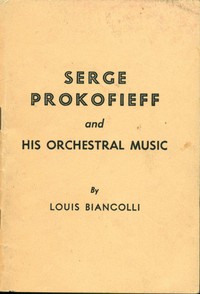
Serge Prokofieff and his orchestral music
Written by Louis Biancolli
Chaptra reads alongside you — AI insights, chapter breakdowns and reader discussions for every book. Join free
About this book
Read it with a club
Small groups reading the same books and talking as they go.


News
- 4 members
- 1,813 discussions
- Active Sep 11
Read Serge Prokofieff and his orchestral music alongside people who are reading it too.
Also here: News Bulletin, Just Joking....
Chaptra Prime — paid clubs, every club feature, and unlimited reading support, for $5 a month or $60 once.
See PrimeReading guide
Themes, characters and key ideas in Serge Prokofieff and his orchestral music, written by Chaptra AI.
- about 12 hours
- intermediate
- Informative
- Analytical
- Biographical
Louis Biancolli's "Serge Prokofieff and his orchestral music" offers a comprehensive exploration of the renowned Russian composer's life and, more specifically, his significant contributions to orchestral literature. The book intertwines biographical details with insightful analyses of Prokofiev's major symphonies, concertos, ballets, and other orchestral works, tracing the evolution of his distinctive compositional voice. Biancolli examines how historical events, personal experiences, and the political climate of both revolutionary Russia and the Soviet Union shaped Prokofiev's artistic output. Through a detailed yet accessible approach, the work aims to illuminate the genius behind Prokofiev's bold harmonies, incisive rhythms, and lyrical melodies, providing context for his lasting impact on 20th-century music.
“Prokofiev's genius lay in his ability to forge a uniquely modern voice without abandoning the melodic and structural principles of classical tradition.”
Key themes
- Innovation and Tradition
- Biancolli consistently highlights Prokofiev's unique ability to push musical boundaries while maintaining a deep respect for classical forms and melodicism. This theme explores how Prokofiev simultaneously embraced modern dissonance and rhythmic complexity, yet structured his works with classical clarity and often infused them with lyrical beauty, exemplified by the 'Classical' Symphony and his concertos. The book delves into how he innovated within established genres rather than entirely abandoning them.
- Artistic Freedom vs. Political Constraint
- This theme explores the profound impact of the Soviet political system, particularly the doctrine of socialist realism, on Prokofiev's compositional choices after his return to Russia. Biancolli examines the tension between Prokofiev's individual artistic vision and the ideological demands for 'accessible,' 'optimistic,' and 'heroic' music that served the state. It addresses how Prokofiev navigated these pressures, sometimes through overt compliance, other times through subtle subversion or by finding personal expression within prescribed forms, often with significant personal and professional consequences.
- The Power of Orchestration and Rhythmic Drive
- Biancolli consistently highlights Prokofiev's masterful and distinctive approach to orchestration and his characteristic use of driving, often percussive rhythms. This theme examines how Prokofiev utilized the full palette of the orchestra to create vibrant textures, sharp contrasts, and a sense of propulsive energy. His orchestration is often described as clear, precise, and brilliant, with a particular flair for brass and percussion, contributing significantly to his unique sound world and the dramatic impact of his music.
Worth discussing
How does Biancolli's analysis connect Prokofiev's personal life and historical context to specific musical characteristics in his orchestral works?
Chapter-by-chapter breakdowns, character arcs and the full thematic analysis come with a free account.
Discussions
No one has started one yet
Questions this book opens up
No discussions yet
Be the first to start a discussion about this book!
Sign up to start the discussionReviews
No reviews yet
Be the first to review this book!