
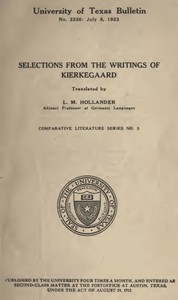
Selections from the Writings of Kierkegaard
Written by Søren Kierkegaard
Chaptra reads alongside you — AI insights, chapter breakdowns and reader discussions for every book. Join free
About this book
Reading guide
Themes, characters and key ideas in Selections from the Writings of Kierkegaard, written by Chaptra AI.
- about 12 hours
- advanced
- philosophical
- introspective
- challenging
This compendium, "Selections from the Writings of Kierkegaard," offers a curated introduction to the profound philosophical contributions of Søren Kierkegaard, a seminal figure in existential thought. Published in the early 20th century, the collection synthesizes key excerpts designed to illuminate his core ideas on individual responsibility, the nature of faith, and the inherent tension between the aesthetic and ethical modes of existence. It commences with a biographical overview, contextualizing Kierkegaard's philosophical development within his personal struggles, including his complex relationship with Regine Olsen and his profound melancholy. Through these selections, readers are invited to engage in a rigorous process of self-examination and delve into the intricate layers of human experience, emphasizing the subjective journey toward meaning and spiritual truth.
“Life can only be understood backwards; but it must be lived forwards.”
Key themes
- Individual Responsibility and Subjectivity
- Kierkegaard places immense emphasis on the individual's solitary journey in making choices, bearing the burden of freedom, and defining oneself. He rejects universal systems and objective truth as sufficient for genuine existence, arguing that 'truth is subjectivity' – a passionate, inward appropriation of truth. This theme underscores the unique and non-transferable nature of each person's existential task.
- Faith and the Religious Stage
- Faith, for Kierkegaard, is not a rational assent to dogma but a passionate, paradoxical, and deeply personal commitment that transcends ethical and aesthetic considerations. It involves a 'leap' beyond finite understanding, an absolute relation to the absolute, often requiring a 'suspension of the ethical.' This theme explores the nature of true religious existence versus superficial 'Christendom.'
- The Aesthetic, Ethical, and Religious Stages of Existence
- This is a fundamental framework Kierkegaard uses to describe different modes of human life and their inherent limitations. The aesthetic life is characterized by immediate gratification, possibility, and avoidance of commitment; the ethical life by adherence to universal moral laws and societal duties; and the religious life by an absolute, passionate, and individual relationship with God that transcends both prior stages.
Worth discussing
How does Kierkegaard's biography inform and shape his philosophical inquiries?
Chapter-by-chapter breakdowns, character arcs and the full thematic analysis come with a free account.
Discussions
No one has started one yet
Questions this book opens up
No discussions yet
Be the first to start a discussion about this book!
Sign up to start the discussionReviews
No reviews yet
Be the first to review this book!