
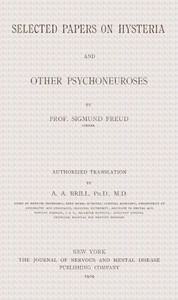
Selected papers on hysteria and other psychoneuroses
Written by Sigmund Freud
Chaptra reads alongside you — AI insights, chapter breakdowns and reader discussions for every book. Join free
About this book
Read it with a club
Small groups reading the same books and talking as they go.


News
- 4 members
- 1,813 discussions
- Active Sep 11
Read Selected papers on hysteria and other psychoneuroses alongside people who are reading it too.
Also here: News Bulletin, Just Joking....
Chaptra Prime — paid clubs, every club feature, and unlimited reading support, for $5 a month or $60 once.
See PrimeReading guide
Themes, characters and key ideas in Selected papers on hysteria and other psychoneuroses, written by Chaptra AI.
- about 30 hours
- advanced
- analytical
- academic
- groundbreaking
Sigmund Freud's "Selected papers on hysteria and other psychoneuroses" is a foundational collection presenting his early, groundbreaking work on the etiology and treatment of neurotic disorders. Spanning critical essays and case studies from the 1890s, the book documents Freud's intellectual journey from a neurological understanding of hysteria to the revolutionary concept of psychogenic origins rooted in repressed memories and unconscious conflicts, particularly those of a sexual nature. It introduces core psychoanalytic concepts such as defense mechanisms, the significance of childhood experiences, and the therapeutic potential of the 'talking cure,' laying the groundwork for his comprehensive theory of the human psyche and its pathologies. This collection marks the definitive departure from traditional medical views of mental illness, establishing the unconscious as a central explanatory principle.
“"Hysterics suffer mainly from reminiscences."”
Key themes
- The Unconscious Mind
- This is the central pillar of Freud's early work. He posits that a significant portion of mental activity occurs outside conscious awareness, yet profoundly influences thoughts, feelings, and behaviors. Neurotic symptoms are understood as manifestations of these hidden, unconscious processes and conflicts. The papers demonstrate how forgotten traumas and repressed desires continue to exert dynamic pressure on the psyche.
- Repression and Defense Mechanisms
- Freud introduces repression as a fundamental defense mechanism where unacceptable thoughts, feelings, or memories are pushed out of conscious awareness into the unconscious. He argues that this process, while initially protective, leads to the formation of neurotic symptoms as the repressed material attempts to find expression. The papers detail how the ego defends itself against distressing internal or external stimuli.
- The Role of Sexuality in Neurosis
- A highly controversial but central theme in these early papers is Freud's assertion of the paramount importance of sexual experiences, particularly those from childhood, in the etiology of neuroses. He initially posited a 'seduction theory,' suggesting actual traumatic sexual experiences as the root cause of hysteria, later broadening this to include psychic reality and fantasies. The papers explore how frustrated, repressed, or traumatic sexual impulses contribute to psychological distress and symptom formation.
Worth discussing
How did Freud's early work challenge prevailing medical and societal views of mental illness in the late 19th century?
Chapter-by-chapter breakdowns, character arcs and the full thematic analysis come with a free account.
Discussions
No one has started one yet
Questions this book opens up
No discussions yet
Be the first to start a discussion about this book!
Sign up to start the discussionReviews
No reviews yet
Be the first to review this book!