
About this book
Reading guide
Themes, characters and key ideas in Selected Essays of Plutarch, Vol. II., written by Chaptra AI.
- about 12 hours
- advanced
- Philosophical
- Reflective
- Historical
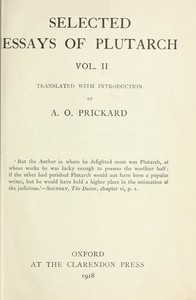
Plutarch's "Selected Essays, Vol. II" is a profound collection of philosophical and moral dialogues from the late first century, deeply rooted in ancient Greek thought. This volume primarily explores the interplay between human character, divine providence, and moral responsibility through essays like "On the Genius of Socrates." Characters engage in rich discussions, notably recounting the historical liberation of Thebes from Spartan rule, using these historical events as a backdrop for examining courage, ethical decision-making, and the mysterious influence of Socrates' divine sign. Plutarch's work is characterized by its deep interest in ethics and virtue, presenting a rigorous inquiry into how these principles manifest in human actions and historical outcomes, offering timeless reflections on the nature of a virtuous life.
“True virtue lies not in the absence of fear, but in triumphing over it for the sake of justice and the common good.”
Key themes
- Ethics and Human Virtue
- This is the foundational theme of Plutarch's work. The essays consistently explore what constitutes a virtuous life, examining qualities like courage, justice, wisdom, and moderation. Through historical examples and philosophical discourse, Plutarch investigates how these virtues are cultivated, tested, and manifested in human actions, particularly in moments of crisis or leadership.
- Divine Providence and Fate
- Plutarch grapples with the extent to which human lives and historical events are influenced by divine forces or predetermined fate. This theme is explored through inquiries into oracles, divine signs, and the concept of an overarching providence, seeking to understand the balance between cosmic design and individual free will.
- Moral Responsibility
- Closely linked with ethics and fate, this theme examines the individual's obligation to make morally sound choices, even in the face of adversity or seemingly predetermined circumstances. Plutarch emphasizes the importance of conscious ethical deliberation and accountability for one's actions and their consequences.
Worth discussing
How does Plutarch's use of historical events, such as the Theban recovery, serve to illustrate his philosophical arguments about virtue and courage?
Chapter-by-chapter breakdowns, character arcs and the full thematic analysis come with a free account.
Discussions
No one has started one yet
Questions this book opens up
No discussions yet
Be the first to start a discussion about this book!
Sign up to start the discussionReviews
No reviews yet
Be the first to review this book!