
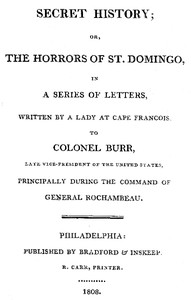
Secret History; or, the Horrors of St. Domingo: In a Series of Letters, Written by a Lady at Cape Francois, to Colonel Burr, Late Vice-President of the United States, Principally During the Command of General Rochambeu
Written by Leonora Sansay
Chaptra reads alongside you — AI insights, chapter breakdowns and reader discussions for every book. Join free
About this book
Reading guide
Themes, characters and key ideas in Secret History; or, the Horrors of St. Domingo: In a Series of Letters, Written by a Lady at Cape Francois, to Colonel Burr, Late Vice-President of the United States, Principally During the Command of General Rochambeu, written by Chaptra AI.
- about 8 hours
- advanced
- despairing
- turbulent
- reflective
Leonora Sansay's "Secret History; or, the Horrors of St. Domingo" is an early 19th-century epistolary novel chronicling the harrowing experiences of an unnamed lady in Cape Francois during the Haitian Revolution, primarily under General Rochambeau's command. Addressed to Colonel Burr, her letters vividly depict the social upheaval, violence, and despair gripping the island. The narrative intertwines the grand historical drama with the protagonist's personal reflections on her arduous journey, the devastation of the town, and the intimate struggles of French families, including her sister's unhappy marriage. Through this unique female perspective, the novel explores themes of gender roles, colonialism, race, and the profound impact of political chaos on individual lives, offering a visceral glimpse into a pivotal historical moment.
“The horrors I witness daily, dear Colonel, beggar description; the very air here is thick with despair and the cries of the oppressed.”
Key themes
- Social Upheaval and Revolution
- The central theme, exploring the chaos, violence, and profound societal transformation brought about by the Haitian Revolution. The novel vividly depicts the breakdown of order, the clash of ideologies, and the devastating impact on all inhabitants.
- Colonialism and Race
- The underlying cause of the Haitian Revolution, this theme examines the brutality of the French colonial system, the dehumanization of enslaved Africans, and the violent struggle for freedom. While reflecting some contemporary biases, it implicitly critiques the inherent injustice of slavery.
- Gender Roles and Female Agency
- Explored through the narrator's confined perspective as a woman, her limited ability to act directly in the political sphere, and the parallel suffering of her sister in an unhappy marriage. It questions the extent of female agency amidst overwhelming external forces.
Worth discussing
How does the epistolary format shape the reader's understanding of the events and the protagonist's perspective?
Chapter-by-chapter breakdowns, character arcs and the full thematic analysis come with a free account.
Discussions
No one has started one yet
Questions this book opens up
No discussions yet
Be the first to start a discussion about this book!
Sign up to start the discussionReviews
No reviews yet
Be the first to review this book!