
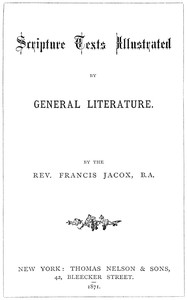
Scripture texts illustrated by general literature
Written by Francis Jacox
Chaptra reads alongside you — AI insights, chapter breakdowns and reader discussions for every book. Join free
About this book
Reading guide
Themes, characters and key ideas in Scripture texts illustrated by general literature, written by Chaptra AI.
- about 8 hours
- advanced
- Reflective
- Intellectual
- Moral
Francis Jacox's "Scripture Texts Illustrated by General Literature" is a unique intellectual endeavor that bridges biblical exegesis with broader literary and philosophical discourse. The work serves as a collection of annotations and reflections, where specific scripture passages are illuminated and deepened through parallels drawn from a wide array of secular literature, poetry, and philosophy. At its core, the book delves into profound moral and ethical themes, such as the nature of sin, collective guilt, and the pervasive impact of individual actions on the community. Through this interdisciplinary approach, Jacox encourages readers to engage in deep contemplation on the enduring relevance of biblical teachings and the universal human condition as reflected across diverse cultural and historical texts.
“No direct quotes available without access to the full text of the book.”
Key themes
- Collective Guilt and Consequence
- This is a central theme, introduced through the biblical story of Achan. Jacox explores how the actions of an individual, particularly moral transgressions, can have far-reaching negative consequences that affect an entire community or society. He uses literature to demonstrate the universal nature of this idea, illustrating how a single person's sin is rarely isolated but rather ripples through interconnected human networks, impacting others through direct or indirect means. The theme encourages contemplation on societal responsibility and accountability.
- Interconnectedness of Humanity
- Building on the theme of collective guilt, Jacox emphasizes that no individual exists or acts in isolation. Human beings are fundamentally linked, and their moral and physical existences are intertwined. This theme posits that understanding the human condition requires acknowledging these intricate connections, where empathy, shared fate, and mutual responsibility are paramount. Literature serves as a mirror reflecting this inherent interconnectedness across diverse cultures and historical periods.
- The Moral and Ethical Dimensions of Life
- The book is fundamentally a work of moral philosophy applied through literary and biblical lenses. Jacox meticulously examines the nature of right and wrong, the implications of moral choices, and the ethical responsibilities individuals hold towards themselves and others. He explores how both scripture and literature provide profound insights into human morality, sin, virtue, and the pursuit of a just life, suggesting a universal human quest for ethical understanding.
Worth discussing
How does Jacox's method of illustrating scripture with general literature enhance or alter one's understanding of biblical texts?
Chapter-by-chapter breakdowns, character arcs and the full thematic analysis come with a free account.
Discussions
No one has started one yet
Questions this book opens up
No discussions yet
Be the first to start a discussion about this book!
Sign up to start the discussionReviews
No reviews yet
Be the first to review this book!