
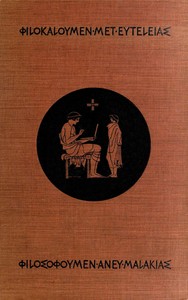
Schools of Hellas: An Essay on the Practice and Theory of Ancient Greek Education from 600 to 300 B. C.
Written by Kenneth J. (Kenneth John) Freeman
Chaptra reads alongside you — AI insights, chapter breakdowns and reader discussions for every book. Join free
About this book
Reading guide
Themes, characters and key ideas in Schools of Hellas: An Essay on the Practice and Theory of Ancient Greek Education from 600 to 300 B. C., written by Chaptra AI.
- about 8 hours
- advanced
- informative
- scholarly
- analytical
Kenneth J. Freeman's "Schools of Hellas" is a seminal early 20th-century scholarly examination of ancient Greek educational practices and philosophies spanning from 600 to 300 B.C. The essay meticulously compares the state-controlled, militarily-focused education of Sparta with the more liberal, diverse, and individually-oriented systems prevalent in Athens. Freeman delves into the underlying ideals—such as citizenship, physical prowess, and intellectual development—that shaped the upbringing of youth in these distinct Greek city-states. The work highlights the profound societal implications of these educational models, revealing how they cultivated character and prepared citizens for their respective roles within the polis. As a foundational text, it offers crucial insights into the historical and cultural significance of education in the ancient Hellenic world.
“"Education in ancient Greece was not merely the acquisition of knowledge, but the very shaping of the citizen's soul for the service of the polis."”
Key themes
- State Control vs. Individual Development
- This theme explores the fundamental divergence in ancient Greek educational philosophies, primarily exemplified by Sparta's rigid, state-mandated system designed to produce uniform, obedient citizens, and Athens' more liberal approach, which, while still serving civic ends, allowed greater scope for individual intellectual and artistic growth. Freeman meticulously details how the degree of state intervention directly shaped the curriculum, pedagogical methods, and ultimate goals for the youth, reflecting distinct political ideologies.
- The Ideal Citizen
- Freeman's analysis consistently ties educational practices to the prevailing ideal of citizenship in each Greek city-state. In Sparta, the ideal citizen was a disciplined, physically formidable soldier, utterly loyal and subservient to the state, with minimal emphasis on individual thought or expression. In Athens, the ideal was a well-rounded, articulate, and intellectually capable individual, active in democratic governance, appreciative of arts, and proficient in rhetoric. The book illustrates how education was the primary mechanism for instilling these specific civic virtues and preparing youth for their adult roles.
- Education as a Foundation of the Polis
- Freeman consistently argues that education was not merely a private affair but the bedrock of the ancient Greek city-state (polis). He demonstrates how the specific educational practices in Sparta and Athens were inextricably linked to their political structures, social hierarchies, and cultural identities. Education served to transmit cultural values, ensure social cohesion, and prepare the next generation to uphold the existing societal order, whether it was a military oligarchy or a burgeoning democracy. The book underscores that the survival and character of the polis depended critically on how its youth were raised.
Worth discussing
How do the educational philosophies of ancient Sparta and Athens compare to modern educational systems, particularly regarding state control versus individual freedom?
Chapter-by-chapter breakdowns, character arcs and the full thematic analysis come with a free account.
Discussions
No one has started one yet
Questions this book opens up
No discussions yet
Be the first to start a discussion about this book!
Sign up to start the discussionReviews
No reviews yet
Be the first to review this book!