
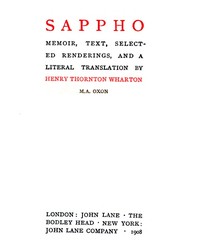
Sappho: Memoir, text, selected renderings, and a literal translation
Written by Henry Thornton Wharton
Chaptra reads alongside you — AI insights, chapter breakdowns and reader discussions for every book. Join free
About this book
Reading guide
Themes, characters and key ideas in Sappho: Memoir, text, selected renderings, and a literal translation, written by Chaptra AI.
- about 8 hours
- advanced
- scholarly
- reverent
- poetic
Henry Thornton Wharton's "Sappho: Memoir, text, selected renderings, and a literal translation" is a pivotal late 19th-century compilation designed to reintroduce the ancient Greek poetess Sappho to English readers. The volume meticulously reconstructs Sappho's life through an extensive memoir, followed by a scholarly presentation of her surviving poetic fragments in their original Greek, alongside various English translations, including Wharton's own literal rendition. Wharton's work laments the historical loss of most of Sappho's oeuvre, emphasizing the profound impact of her surviving verses on lyric poetry and her mastery of emotive expression. Through detailed prefaces, Wharton articulates his intent to make every known fragment accessible, highlighting the challenges and nuances involved in translating such deeply lyrical and ancient material.
“I have endeavoured to familiarise my readers with every known fragment of Sappho's poetry.”
Key themes
- The Power and Fragility of Poetry/Art
- This theme is central to Wharton's work, highlighted by his profound lament over the vast majority of Sappho's poetry being lost to history. The book itself is a testament to the enduring power of the few fragments that survived, demonstrating how even incomplete works can shape literary history and influence generations. It explores the precariousness of cultural heritage and the human effort required to preserve what remains.
- The Act of Translation and Interpretation
- Wharton's book is a masterclass in the complexities of translation. By providing the original Greek, various poetic renderings, and his own literal translation, he implicitly and explicitly discusses the challenges of conveying the nuances, rhythm, and emotional depth of ancient lyric poetry into a different language and cultural context. It highlights that translation is always an act of interpretation, with each version offering a distinct perspective.
- Sappho's Legacy and Influence
- The entire book is a testament to Sappho's enduring legacy. Wharton positions her as a foundational figure in lyric poetry, whose mastery of emotion and form profoundly impacted subsequent poets and literary traditions. The memoir and the scholarly apparatus aim to solidify her place in the Western canon, despite the fragmentary nature of her surviving work, highlighting her unique and powerful voice.
Worth discussing
What are the inherent challenges and ethical considerations in translating ancient, fragmented poetry like Sappho's?
Chapter-by-chapter breakdowns, character arcs and the full thematic analysis come with a free account.
Discussions
No one has started one yet
Questions this book opens up
No discussions yet
Be the first to start a discussion about this book!
Sign up to start the discussionReviews
No reviews yet
Be the first to review this book!