
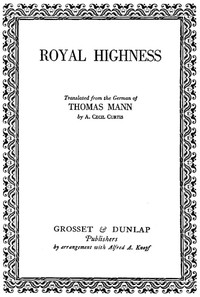
Royal Highness
Written by Thomas Mann
Chaptra reads alongside you — AI insights, chapter breakdowns and reader discussions for every book. Join free
About this book
Reading guide
Themes, characters and key ideas in Royal Highness, written by Chaptra AI.
- about 10 hours
- advanced
- reflective
- formal
- melancholy
Thomas Mann's "Royal Highness" is a poignant exploration of the burdens of aristocracy and the search for individual identity amidst the strictures of public duty. The novel centers on Prince Klaus Heinrich, the younger brother of the melancholic Grand Duke Albrecht II, who grapples with the expectations of his inherited status and a physical imperfection – a stunted hand. Through his journey, Mann contrasts the opulent facade of royal life with the personal vulnerabilities and existential struggles of those within it. The narrative culminates in Klaus Heinrich's acceptance of his symbolic role and his marriage to the wealthy American heiress Imma Spoelmann, blending old-world tradition with modern pragmatism.
“"He was not a human being, but a royal highness."”
Key themes
- Duty vs. Individuality
- This is the central conflict of the novel, exploring the tension between Klaus Heinrich's personal desires and his inherited obligation to his people and his royal station. He struggles to reconcile his inner self with the public persona he is expected to embody, ultimately finding a way to integrate both.
- Appearance vs. Reality
- The novel meticulously details the elaborate facade of royal life – the ceremonies, titles, and public appearances – contrasting it with the often mundane, melancholic, or conflicted realities of the characters' inner lives. It questions the nature of authenticity when one's entire existence is a performance.
- The Burden and Decay of Aristocracy
- Mann explores the anachronistic nature of European royalty in the early 20th century. The Grand Duchy is financially struggling, and its rulers are often burdened and melancholic, suggesting that the old order is fading. The arrival of American wealth highlights the shifting power dynamics.
Worth discussing
How does Klaus Heinrich's physical imperfection (his stunted hand) symbolize his broader struggle with his royal identity?
Chapter-by-chapter breakdowns, character arcs and the full thematic analysis come with a free account.
Discussions
No one has started one yet
Questions this book opens up
No discussions yet
Be the first to start a discussion about this book!
Sign up to start the discussionReviews
No reviews yet
Be the first to review this book!