
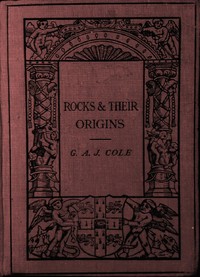
Rocks and Their Origins
Written by Grenville A. J. (Grenville Arthur James) Cole
Chaptra reads alongside you — AI insights, chapter breakdowns and reader discussions for every book. Join free
About this book
Reading guide
Themes, characters and key ideas in Rocks and Their Origins, written by Chaptra AI.
- about 8 hours
- intermediate
- informative
- educational
- foundational
Rocks and Their Origins by Grenville A. J. Cole is an early 20th-century scientific publication serving as an accessible introductory text on geology for non-specialists. The book aims to bridge the gap between scientific study and natural history, making the fundamental aspects of rocks and their formation relevant to general readers and travelers. It systematically explores various rock types, such as limestones, sandstones, and slates, detailing their origins and significance within the Earth's crust. Cole emphasizes a crucial shift in geology from mere classification to a deeper appreciation of the dynamic processes that shape landscapes and highlights the indispensable role of field research in understanding Earth's geological history.
“To understand the rocks beneath our feet is to comprehend the very pulse of Earth's ancient history.”
Key themes
- The Dynamic Earth and Geological Processes
- This theme underscores Cole's departure from a purely static, classification-based view of geology. The book emphasizes that rocks are not merely inert objects but products of continuous, powerful processes—erosion, deposition, metamorphism, volcanism—that have shaped and continue to shape the Earth over vast spans of time. It encourages readers to perceive the planet as an active, evolving system, constantly undergoing transformation.
- The Importance of Field Research and Empirical Observation
- Cole champions direct observation in natural settings as crucial for true geological understanding. He argues that laboratory analysis, while valuable, cannot fully capture the scale, context, and interrelationships of geological phenomena. This theme stresses the empirical nature of geology and the necessity of hands-on engagement with the landscape to interpret its history and processes accurately.
- Accessibility and Interdisciplinary Nature of Geology
- A core aim of the book is to make geology understandable and relevant to non-specialists, effectively bridging the gap between scientific academia and the general public. It connects geological concepts to natural history, travel, and everyday observations, thereby advocating for geology as an integral part of a broader understanding of the natural world, rather than an esoteric or isolated scientific discipline.
Worth discussing
How does Cole's approach to connecting geology with 'natural history' influence the accessibility and appeal of the subject?
Chapter-by-chapter breakdowns, character arcs and the full thematic analysis come with a free account.
Discussions
No one has started one yet
Questions this book opens up
No discussions yet
Be the first to start a discussion about this book!
Sign up to start the discussionReviews
No reviews yet
Be the first to review this book!