
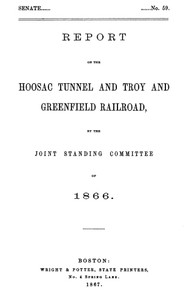
Report of the Hoosac Tunnel and Troy and Greenfield Railroad, by the Joint Standing Committee of 1866.
Written by Tappan Wentworth
Chaptra reads alongside you — AI insights, chapter breakdowns and reader discussions for every book. Join free
About this book
Reading guide
Themes, characters and key ideas in Report of the Hoosac Tunnel and Troy and Greenfield Railroad, by the Joint Standing Committee of 1866., written by Chaptra AI.
- about 10 hours
- advanced
- Informative
- Formal
- Analytical
The 'Report of the Hoosac Tunnel and Troy and Greenfield Railroad' by the Joint Standing Committee of 1866 offers a meticulous mid-19th-century account of a critical infrastructure project in Massachusetts. Authored by Tappan Wentworth, this document details the financial state, engineering challenges, and legislative oversight surrounding the ambitious Hoosac Tunnel and its connecting railroad. It reveals significant financial mismanagement and operational difficulties, which ultimately led to the original contractors abandoning the project and the State of Massachusetts assuming control. The report serves as a vital historical record, providing insights into 19th-century public works, engineering practices, and the complexities of large-scale government-backed ventures.
“"The Committee, after careful and repeated examinations of the Hoosac Tunnel and the Troy and Greenfield Railroad, found the financial condition of the corporation to be one of profound embarrassment and questionable management."”
Key themes
- Government Oversight and Accountability
- The report fundamentally explores the necessity and mechanisms of government oversight in projects receiving public funds. It details the committee's investigative process, highlighting the importance of transparency, financial accountability, and legislative scrutiny to prevent mismanagement and ensure project success. The State's eventual takeover underscores the ultimate responsibility of government.
- Challenges of Infrastructure Development
- This theme details the immense practical, technical, and logistical hurdles inherent in undertaking a massive engineering project like the Hoosac Tunnel in the 19th century. It covers geological complexities, limitations of available technology, labor organization, and the sheer scale of effort required, often under unpredictable conditions.
- Financial Mismanagement and Investment Risk
- The report meticulously uncovers the financial irregularities and poor management that plagued the Troy and Greenfield Railroad Corporation. It highlights issues such as insufficient capital, questionable accounting practices, and the misuse or misallocation of state funds, demonstrating the significant risks involved in financing large-scale ventures without stringent financial controls.
Worth discussing
What does this report reveal about the nature of large-scale infrastructure projects in the 19th century?
Chapter-by-chapter breakdowns, character arcs and the full thematic analysis come with a free account.
Discussions
No one has started one yet
Questions this book opens up
No discussions yet
Be the first to start a discussion about this book!
Sign up to start the discussionReviews
No reviews yet
Be the first to review this book!