
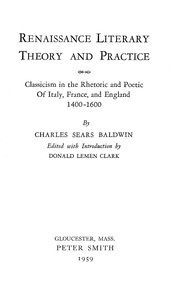
Renaissance literary theory and practice : $b Classicism in the rhetoric and poetic of Italy, France, and England 1400-1600
Written by Charles Sears Baldwin
Chaptra reads alongside you — AI insights, chapter breakdowns and reader discussions for every book. Join free
About this book
Reading guide
Themes, characters and key ideas in Renaissance literary theory and practice : $b Classicism in the rhetoric and poetic of Italy, France, and England 1400-1600, written by Chaptra AI.
- about 8 hours
- advanced
- scholarly
- informative
- analytical
Charles Sears Baldwin's "Renaissance Literary Theory and Practice" offers a foundational academic examination of classicism's resurgence in European literature between 1400 and 1600. The book meticulously traces how the Renaissance, perceived as a 'new day' after medieval decline, re-engaged with classical rhetoric and poetic traditions. Baldwin explores this intellectual and cultural shift across Italy, France, and England, demonstrating how the revival of ancient texts and the printing press catalyzed humanistic literary movements. He distinguishes between different literary forms and rhetorical structures, providing a comprehensive framework for understanding the period's significant figures and texts. Ultimately, the work illuminates the profound and lasting impact of classical ideals on the development of modern Western literature.
“The Renaissance was a self-proclaimed 'new day' in literary history, reconnecting with classical traditions after a perceived period of medieval decline.”
Key themes
- Classicism and Revival
- This is the central theme, exploring how the Renaissance marked a deliberate return to and reinterpretation of ancient Greek and Roman literary and rhetorical traditions. Baldwin details the mechanisms of this revival, from the rediscovery of texts to their scholarly study and creative application, emphasizing its transformative impact on European culture.
- Rhetoric vs. Poetic
- Baldwin meticulously distinguishes between the theoretical frameworks of rhetoric (the art of effective or persuasive speaking or writing) and poetic (the theory of poetry and literary forms). He examines how Renaissance scholars and writers understood, debated, and applied these distinct but often overlapping classical disciplines in their own works.
- Humanism and Education
- The book implicitly and explicitly explores the role of Renaissance humanism as the intellectual engine behind the classical revival. Humanism, with its emphasis on human agency, classical learning, and a broad liberal education (studia humanitatis), provided the philosophical and pedagogical framework for studying and disseminating ancient texts, fundamentally reshaping educational curricula and intellectual pursuits.
Worth discussing
How did the concept of the Renaissance as a 'new day' influence literary production and critical reception during the period?
Chapter-by-chapter breakdowns, character arcs and the full thematic analysis come with a free account.
Discussions
No one has started one yet
Questions this book opens up
No discussions yet
Be the first to start a discussion about this book!
Sign up to start the discussionReviews
No reviews yet
Be the first to review this book!