
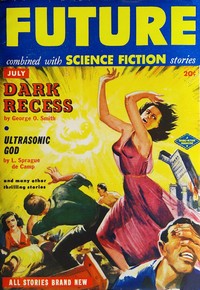
Remember the 4th!
Written by Noel M. Loomis
Chaptra reads alongside you — AI insights, chapter breakdowns and reader discussions for every book. Join free
About this book
Reading guide
Themes, characters and key ideas in Remember the 4th!, written by Chaptra AI.
- about 6 hours
- intermediate
- humorous
- mysterious
- thought-provoking
Noel M. Loomis's "Remember the 4th!" is an early 1950s science fiction story centered on the Brain-Finder, a device capable of replaying personal memories. Private investigators Doc Hambright and Slim Coleman, struggling financially, invent the device and quickly stumble upon a personal secret involving their landlord and his wife. Their subsequent use of the Brain-Finder for a wealthy client, Tom Ellingbery, uncovers a web of romantic entanglements and forces them to confront profound ethical questions about privacy and the nature of truth. The narrative culminates in a dramatic court scene where Doc destroys the device to protect personal lives, leading to an unexpected reconciliation for the Ellingberys, while the investigators remain comically unaware of the deeper emotional outcomes.
“"The Brain-Finder isn't just a gadget, Slim. It's a window into the soul, and sometimes what you see isn't meant for anyone else's eyes."”
Key themes
- Privacy and Voyeurism
- This theme explores the ethical boundaries of personal privacy when technology allows for complete visual access to one's most intimate moments. The Brain-Finder turns private lives into public spectacles, forcing a confrontation with the morality of voyeurism and the right to keep aspects of one's life hidden.
- Memory and the Past
- The central theme revolves around the nature of memory and its accessibility. The Brain-Finder allows for perfect recall, raising questions about whether reliving the past is always beneficial, or if certain memories are better left undisturbed or subject to the natural filtering of time.
- Technology and Ethics
- Loomis uses the Brain-Finder to examine the moral implications of scientific advancement. The device itself is neutral, but its application raises questions about the responsibility of inventors, the potential for misuse, and the unforeseen consequences of technology on human relationships and society.
Worth discussing
How does the Brain-Finder challenge traditional notions of privacy, and what are the modern parallels to this invasion of personal space?
Chapter-by-chapter breakdowns, character arcs and the full thematic analysis come with a free account.
Discussions
No one has started one yet
Questions this book opens up
No discussions yet
Be the first to start a discussion about this book!
Sign up to start the discussionReviews
No reviews yet
Be the first to review this book!