
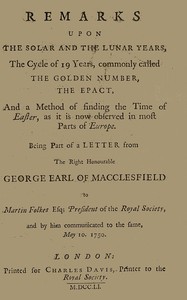
Remarks upon the solar and the lunar years, the cycle of 19 years, commonly called the golden number, the epact, and a method of finding the time of Easter, as it is now observed in most parts of Europe
Written by George Parker Macclesfield
Chaptra reads alongside you — AI insights, chapter breakdowns and reader discussions for every book. Join free
About this book
Reading guide
Themes, characters and key ideas in Remarks upon the solar and the lunar years, the cycle of 19 years, commonly called the golden number, the epact, and a method of finding the time of Easter, as it is now observed in most parts of Europe, written by Chaptra AI.
- about 8 hours
- advanced
- analytical
- precise
- scholarly
George Parker, Earl of Macclesfield's mid-18th century scientific treatise, 'Remarks upon the solar and the lunar years,' meticulously dissects the complexities of calendrical calculations, specifically focusing on the accurate determination of Easter's date. Presented as a letter to Martin Folkes of the Royal Society, the work elucidates the mathematical interplay between the solar year, lunar year, the 19-year Metonic cycle (Golden Number), and the Epact. It critically examines the discrepancies inherent in the Julian and Gregorian calendars, proposing a rigorous method for adjusting the Golden Numbers to ensure the Paschal Full Moon aligns precisely with astronomical phenomena. The publication serves as a pivotal document in the history of timekeeping, advocating for scientific accuracy in both secular and religious calendrical practices across Europe.
“The accurate reconciliation of the solar and lunar periods stands as a perpetual challenge to human ingenuity and observation.”
Key themes
- Calendrical Reform and Accuracy
- The core theme of the book is the necessity and methodology of reforming calendrical systems to achieve astronomical accuracy. Macclesfield meticulously details the historical inaccuracies of the Julian calendar and the traditional Golden Number system, advocating for a scientifically rigorous approach to timekeeping, particularly for the determination of Easter. This theme highlights the ongoing human endeavor to synchronize human conventions with natural phenomena.
- The Intersection of Science and Religion
- Macclesfield's work directly addresses how scientific principles (astronomy, mathematics) are applied to resolve an issue with profound religious significance – the date of Easter. This theme explores the historical tension and eventual synthesis between scientific understanding of the natural world and the established practices of religious institutions, demonstrating how scientific inquiry can serve to refine and rationalize religious observance.
- The Nature of Scientific Discourse and Collaboration
- Presented as a letter to the President of the Royal Society, the book exemplifies the structured, peer-to-peer scientific communication prevalent in the 18th century. It showcases how scientific problems were identified, solutions proposed, and knowledge disseminated and debated within an intellectual community. This theme highlights the collaborative, yet critical, process of scientific advancement.
Worth discussing
How does Macclesfield's work exemplify the Enlightenment's emphasis on reason and scientific reform?
Chapter-by-chapter breakdowns, character arcs and the full thematic analysis come with a free account.
Discussions
No one has started one yet
Questions this book opens up
No discussions yet
Be the first to start a discussion about this book!
Sign up to start the discussionReviews
No reviews yet
Be the first to review this book!