
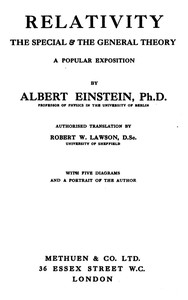
Relativity: The Special & the General Theory: A Popular Exposition, 3rd ed.
Written by Albert Einstein
Chaptra reads alongside you — AI insights, chapter breakdowns and reader discussions for every book. Join free
About this book
This work by Einstein, Albert offers readers a unique literary experience. The narrative explores themes of relativity (physics).
Reading guide
Themes, characters and key ideas in Relativity: The Special & the General Theory: A Popular Exposition, 3rd ed., written by Chaptra AI.
- about 8 hours
- advanced
- intellectual
- explanatory
- profound
Albert Einstein's 'Relativity: The Special & the General Theory' is a monumental work, offering a direct and accessible exposition of his groundbreaking theories for the educated layperson. Published shortly after the experimental confirmation of General Relativity, the book meticulously builds an understanding of both Special and General Relativity, starting from fundamental principles and employing intuitive thought experiments. It systematically dismantles classical notions of absolute space and time, introducing a universe where these concepts are relative to the observer's motion and gravity is a manifestation of space-time curvature. This classic remains an invaluable primary source for grasping the conceptual revolution brought about by Einstein's work.
“The laws of physics must be the same for all observers moving at constant velocities relative to each other.”
Key themes
- The Relativity of Space and Time
- This theme is central to both Special and General Relativity, asserting that measurements of space and time are not absolute but depend on the relative motion of the observer. Einstein meticulously explains how concepts like simultaneity, length, and duration are relative, challenging the Newtonian view of an absolute, unchanging space and time. This leads to the revolutionary idea of space and time being interwoven into a single four-dimensional continuum.
- Gravity as Geometry
- This is the core insight of General Relativity. Einstein demonstrates that gravity is not a force pulling objects together, but rather a manifestation of the curvature of space-time caused by the presence of mass and energy. Objects (and light) follow the 'straightest possible path' through this curved space-time, which we perceive as gravity.
- The Power of Thought Experiments
- Throughout the book, Einstein relies heavily on 'Gedankenexperimente' (thought experiments) to illustrate complex concepts and derive profound conclusions without extensive mathematics. These imaginary scenarios, such as the moving train, the light clock, or the accelerating elevator, allow readers to intuitively grasp the logical consequences of the postulates of relativity, challenging their conventional understanding of reality.
Worth discussing
How does Einstein's use of thought experiments facilitate understanding of complex concepts, and what are their limitations?
Chapter-by-chapter breakdowns, character arcs and the full thematic analysis come with a free account.
Discussions
No one has started one yet
Questions this book opens up
No discussions yet
Be the first to start a discussion about this book!
Sign up to start the discussionReviews
No reviews yet
Be the first to review this book!