
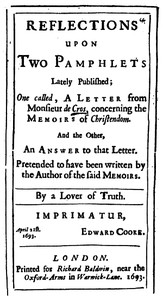
Reflections upon Two Pamphlets Lately Published: One called, A Letter from Monsieur de Cros, concerning the Memoirs of Christendom, and the Other, An Answer to that Letter.
Written by Anonymous
Chaptra reads alongside you — AI insights, chapter breakdowns and reader discussions for every book. Join free
About this book
Reading guide
Themes, characters and key ideas in Reflections upon Two Pamphlets Lately Published: One called, A Letter from Monsieur de Cros, concerning the Memoirs of Christendom, and the Other, An Answer to that Letter., written by Chaptra AI.
- about 8 hours
- advanced
- argumentative
- critical
- polemical
Reflections upon Two Pamphlets Lately Published is an anonymous late 17th-century critical response to a political controversy unfolding through public pamphlets. The author meticulously dissects a letter by Monsieur de Cros, which vehemently attacks the reputation and integrity of Sir W. Temple, and also considers an 'Answer' to de Cros's letter. Primarily, the anonymous author takes a strong stand against de Cros's accusations, branding them as mendacious and scurrilous, and passionately defends Sir W. Temple's character and public service. The text serves as a powerful argument for truth, reasoned discourse, and integrity in public life, lamenting the prevalence of character assassination in contemporary political debates. It offers a window into the intense political and social climate of the era, where reputation was paramount and public discourse often took a polemical turn.
“It is a lamentable age when calumny and falsehood are peddled as truth in the public square, tarnishing reputations built upon years of honest service.”
Key themes
- Reputation and Honor
- In the late 17th century, a person's reputation and honor were paramount, particularly for public figures. This theme is central as the entire book is a defense of Sir W. Temple's good name against the 'scurrilous' attacks of Monsieur de Cros. The anonymous author underscores the devastating impact of calumny and the moral imperative to defend a slandered reputation.
- Truth vs. Mendacity
- This theme forms the ethical core of the 'Reflections.' The anonymous author consistently champions truth and intellectual honesty, contrasting them sharply with the 'mendacious' and 'false' claims made by Monsieur de Cros. The author argues that public discourse should be grounded in verifiable facts and reasoned arguments, not personal attacks or fabrications.
- Public Discourse and Polemics
- The book itself is a product of and a commentary on the nature of public discourse in the late 17th century, particularly the role of pamphlets in political debate. It highlights the often-aggressive and personal nature of polemical writing, while simultaneously advocating for a more dignified and principled approach to public communication.
Worth discussing
How does the anonymous author's defense of Sir W. Temple reflect the values and anxieties regarding reputation in the late 17th century?
Chapter-by-chapter breakdowns, character arcs and the full thematic analysis come with a free account.
Discussions
No one has started one yet
Questions this book opens up
No discussions yet
Be the first to start a discussion about this book!
Sign up to start the discussionReviews
No reviews yet
Be the first to review this book!