
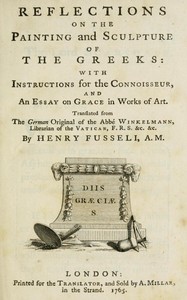
Reflections on the painting and sculpture of the Greeks : $b with instructions for the connoisseur, and an essay on grace in works of art
Written by Johann Joachim Winckelmann
Chaptra reads alongside you — AI insights, chapter breakdowns and reader discussions for every book. Join free
About this book
Reading guide
Themes, characters and key ideas in Reflections on the painting and sculpture of the Greeks : $b with instructions for the connoisseur, and an essay on grace in works of art, written by Chaptra AI.
- about 12 hours
- advanced
- Scholarly
- Didactic
- Reverent
Johann Joachim Winckelmann's "Reflections on the Painting and Sculpture of the Greeks," translated by Henry Fuseli, is a seminal 18th-century work of art history and aesthetic theory. It meticulously examines the unique qualities of ancient Greek art, particularly its sculpture, advocating for its unparalleled excellence and serving as a foundational text for Neoclassicism. Winckelmann posits that Greek art achieved an ideal beauty through elements like 'noble simplicity and quiet grandeur,' influenced by the Greek environment, athletic culture, and philosophical ideals. The book not only details these aesthetic principles but also provides guidance for connoisseurs and artists, urging a return to classical forms and an emulation of ancient mastery to elevate contemporary art practices. It profoundly shaped subsequent perceptions of classical antiquity and the development of modern art criticism.
“The only way for us to become great, nay, inimitable, if it is possible, is to imitate the ancients.”
Key themes
- The Supremacy of Greek Art
- Winckelmann's central thesis is the unparalleled excellence and ideal beauty found in ancient Greek painting and sculpture. He systematically argues that Greek artists achieved a level of perfection, particularly in the representation of the human form, that has never been surpassed. This theme underpins all other discussions in the book, establishing Greek art as the ultimate benchmark for artistic achievement.
- Ideal Beauty and Aesthetic Principles
- Winckelmann explores the theoretical underpinnings of beauty, particularly 'ideal beauty,' which he distinguishes from mere natural beauty. He posits that Greek artists abstracted and perfected forms, combining the finest elements observed in nature to create a heightened, more divine representation. This theme delves into the specific aesthetic principles (contour, drapery, expression, proportion) that contribute to this ideal.
- The Influence of Culture on Art
- Winckelmann argues that the unique conditions of ancient Greek society—its climate, political freedom, religious practices, and especially its athletic culture and reverence for the nude human body—were crucial in fostering their artistic genius. This theme explores the symbiotic relationship between a civilization's environment and values, and the art it produces.
Worth discussing
How does Winckelmann's concept of 'noble simplicity and quiet grandeur' define ideal beauty, and is it still relevant in contemporary art criticism?
Chapter-by-chapter breakdowns, character arcs and the full thematic analysis come with a free account.
Discussions
No one has started one yet
Questions this book opens up
No discussions yet
Be the first to start a discussion about this book!
Sign up to start the discussionReviews
No reviews yet
Be the first to review this book!