
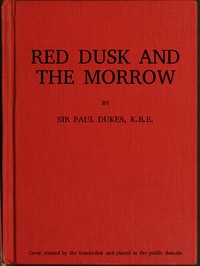
Red Dusk and the Morrow: Adventures and Investigations in Red Russia
Written by Paul Dukes
Chaptra reads alongside you — AI insights, chapter breakdowns and reader discussions for every book. Join free
About this book
Reading guide
Themes, characters and key ideas in Red Dusk and the Morrow: Adventures and Investigations in Red Russia, written by Chaptra AI.
- about 10 hours
- advanced
- Tense
- Investigative
- Perilous
Paul Dukes's "Red Dusk and the Morrow" offers a compelling firsthand account of post-revolutionary Russia, detailing his perilous experiences as a British Secret Intelligence Service agent amidst the turbulent rise of Bolshevism. The narrative vividly captures the chaotic social and political upheaval in Petrograd, transitioning from an initial observer's perspective to active involvement in espionage. Dukes interweaves personal reflections with acute observations on the profound impact of the revolution on the Russian populace and the inherent contradictions within revolutionary ideals versus reality. The book serves as both an adventure memoir and a critical investigation into a pivotal historical period, revealing the dangers and complexities faced by an individual navigating a society in profound flux. It ultimately portrays a journey from hopeful anticipation to a sobering confrontation with danger and disillusionment.
“"The air itself seemed charged with revolution, a mixture of intoxicating hope and an undercurrent of palpable dread."”
Key themes
- The Disillusionment of Revolution
- This theme explores the stark contrast between the utopian ideals and promises of the Russian Revolution and its brutal, chaotic, and often repressive reality. Dukes witnesses firsthand the widespread suffering, political purges, and the failure of revolutionary rhetoric to translate into improved lives for the majority. The initial excitement gives way to fear and disillusionment.
- Espionage and Moral Ambiguity
- The book delves into the complex world of intelligence gathering during wartime, highlighting the ethical dilemmas, psychological toll, and constant deception inherent in a spy's life. Dukes operates in a morally grey area, where truth is a weapon and trust is a liability, forcing him to constantly question his actions and their implications.
- Chaos and Societal Breakdown
- Dukes vividly portrays the breakdown of social order, institutions, and daily life in post-revolutionary Russia. The narrative is replete with descriptions of disorder, violence, scarcity, and the general confusion that permeated all levels of society, illustrating the fragility of civilization when political structures collapse.
Worth discussing
How does Dukes's dual role as an observer and an active participant shape the narrative and our understanding of the Russian Revolution?
Chapter-by-chapter breakdowns, character arcs and the full thematic analysis come with a free account.
Discussions
No one has started one yet
Questions this book opens up
No discussions yet
Be the first to start a discussion about this book!
Sign up to start the discussionReviews
No reviews yet
Be the first to review this book!