
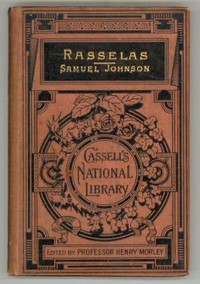
About this book
Read it with a club
Small groups reading the same books and talking as they go.


News
- 4 members
- 1,813 discussions
- Active Sep 11
Read Rasselas, Prince of Abyssinia alongside people who are reading it too.
Also here: News Bulletin, Just Joking....
Chaptra Prime — paid clubs, every club feature, and unlimited reading support, for $5 a month or $60 once.
See PrimeReading guide
Themes, characters and key ideas in Rasselas, Prince of Abyssinia, written by Chaptra AI.
- about 8 hours
- advanced
- philosophical
- contemplative
- melancholy
Samuel Johnson's "Rasselas, Prince of Abyssinia" is a profound philosophical novella exploring the universal human quest for happiness. The narrative follows Prince Rasselas, who, despite living in the seemingly perfect 'Happy Valley,' experiences profound discontent and yearns for a purposeful life beyond its sheltered confines. Accompanied by his wise mentor Imlac, his sister Nekayah, and her attendant Pekuah, Rasselas escapes to explore the world, observing various lifestyles—from hermits to philosophers, shepherds to kings—all in search of a state of lasting contentment. Through their extensive travels and observations, the party ultimately concludes that perfect happiness is elusive and unattainable in human life, leading to a pragmatic acceptance of life's inherent mixture of good and evil.
“Human life is everywhere a state in which much is to be endured, and little to be enjoyed.”
Key themes
- The Futility of the Quest for Perfect Happiness
- This is the central, overarching theme of the novel. Johnson argues that perfect, unalloyed happiness is an unattainable ideal in human life. Every state, condition, or profession observed by Rasselas and his companions is found to be marred by some form of discontent, anxiety, illusion, or suffering, demonstrating that human desires are insatiable and that earthly contentment is always fleeting.
- The Nature of Human Desire and Discontent
- Johnson explores the inherent restlessness and insatiability of human desire. Even when all physical needs are met, as in the Happy Valley, the human mind yearns for purpose, novelty, and meaning, leading to an inevitable dissatisfaction with any static state. This discontent is presented as a fundamental aspect of human psychology, driving individuals to seek beyond their current circumstances.
- The Illusion of Paradise and Utopian Ideals
- The Happy Valley serves as a central symbol for the impossibility of creating a perfect, problem-free society or personal paradise. Despite its beauty and abundance, it fails to satisfy the human spirit, demonstrating that external conditions alone cannot guarantee internal fulfillment. This theme critiques utopian visions and highlights the inherent flaws in any attempt to escape the complexities of human nature.
Worth discussing
Is true happiness attainable in human life, according to Johnson? Do you agree with his assessment?
Chapter-by-chapter breakdowns, character arcs and the full thematic analysis come with a free account.
Discussions
No one has started one yet
Questions this book opens up
No discussions yet
Be the first to start a discussion about this book!
Sign up to start the discussionReviews
No reviews yet
Be the first to review this book!