
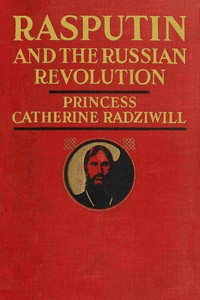
Rasputin and the Russian Revolution
Written by Catherine Radziwill
Chaptra reads alongside you — AI insights, chapter breakdowns and reader discussions for every book. Join free
About this book
Reading guide
Themes, characters and key ideas in Rasputin and the Russian Revolution, written by Chaptra AI.
- about 10 hours
- advanced
- historical
- analytical
- intriguing
Princess Catherine Radziwill's "Rasputin and the Russian Revolution" offers an early 20th-century historical account of Grigori Rasputin's life and profound influence on the Russian court, leading up to the 1917 Revolution. The book aims to strip away the sensationalism surrounding Rasputin, presenting him as a cunning opportunist rather than a purely mystical figure. Radziwill meticulously details his rise from a Siberian peasant to a powerful confidant of Empress Alexandra, scrutinizing the political and personal dynamics that entangled the Romanoff dynasty with this controversial figure. By contrasting public myth with what she posits as a more mundane, albeit manipulative, reality, the author provides an insider's perspective on the internal decay and external pressures that culminated in the fall of the empire.
“"The tragedy of Russia was not so much in the villainy of one man, but in the weakness of many, and the blind faith of a few."”
Key themes
- The Corrupting Nature of Power and Influence
- The book vividly illustrates how Rasputin, despite lacking formal authority, wielded immense power through his manipulation of the Empress. This theme explores how unchecked influence can corrupt individuals, lead to poor governance, and ultimately destabilize an entire nation. Radziwill shows that power, even when indirect, can be profoundly destructive when used for personal gain or based on irrational foundations.
- Superstition vs. Political Reality
- Radziwill highlights the dangerous clash between the Empress's deep-seated mystical beliefs and the pragmatic demands of governing a vast empire. The reliance on a 'holy man' for political and personal guidance, rather than rational counsel, is presented as a critical factor in the Romanoff dynasty's downfall. The book explores how superstition, when it infiltrates the highest levels of power, can lead to catastrophic political misjudgments.
- Political Decay and the Inevitability of Revolution
- The book portrays Rasputin not merely as a direct cause but as a potent symptom and accelerant of the Romanoff dynasty's inherent weaknesses and the broader political decay within Russia. It details how the Tsar's indecisiveness, the Empress's isolation, and the court's corruption created a fertile ground for revolutionary sentiment, making the ultimate collapse of the empire seem almost inevitable.
Worth discussing
To what extent was Rasputin a cause of the Russian Revolution, versus a symptom of deeper societal and political problems?
Chapter-by-chapter breakdowns, character arcs and the full thematic analysis come with a free account.
Discussions
No one has started one yet
Questions this book opens up
No discussions yet
Be the first to start a discussion about this book!
Sign up to start the discussionReviews
No reviews yet
Be the first to review this book!