
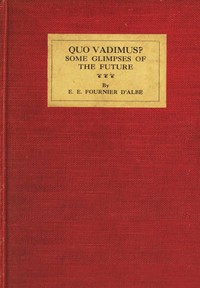
Quo vadimus? : $b Some glimpses of the future
Written by E. E. (Edmund Edward) Fournier d'Albe
Chaptra reads alongside you — AI insights, chapter breakdowns and reader discussions for every book. Join free
About this book
Reading guide
Themes, characters and key ideas in Quo vadimus? : $b Some glimpses of the future, written by Chaptra AI.
- about 10 hours
- advanced
- Thought-provoking
- Speculative
- Optimistic
E. E. Fournier d'Albe's "Quo vadimus? : Some glimpses of the future" is an early 20th-century scientific and philosophical inquiry into humanity's long-term prospects. The book posits that despite environmental challenges threatening other species, humans possess a unique capacity for adaptation, ensuring survival over millions of years. It explores the intricate interplay of scientific advancements, societal evolution, and environmental factors shaping human destiny, emphasizing psychological needs, sustenance, and the imperative for intellectual and social growth. Fournier d'Albe envisions a future marked by global unity, advanced technology, disease eradication, and extended lifespans, all under a single world government. However, he critically warns that humanity's greatest threat may stem not from external forces, but from its own internal will and choices, ultimately advocating for collective progress and collaboration.
“While environmental changes may threaten other species, humans possess a unique ability to adapt.”
Key themes
- Human Adaptability and Evolution
- This is the core thesis of the book, arguing that humanity's unique capacity for adaptation—beyond mere biological evolution, extending to social, technological, and intellectual realms—ensures its survival over vast periods, unlike other species threatened by environmental change.
- Technological and Social Progress
- The book forecasts significant advancements in technology (e.g., disease elimination, extended lifespans) and social structures (e.g., global unity, single government). It portrays progress as an inevitable and desirable trajectory, leading to a more advanced and harmonious human existence.
- Existential Threats: Internal vs. External
- A critical theme is the distinction between external dangers (environmental changes) and internal dangers (human will, choices, and potential for self-destruction). The book posits that humanity's ultimate downfall is more likely to arise from its own actions and decisions than from external forces.
Worth discussing
To what extent do you agree with Fournier d'Albe's assertion that human adaptability is our greatest strength against existential threats?
Chapter-by-chapter breakdowns, character arcs and the full thematic analysis come with a free account.
Discussions
No one has started one yet
Questions this book opens up
No discussions yet
Be the first to start a discussion about this book!
Sign up to start the discussionReviews
No reviews yet
Be the first to review this book!