
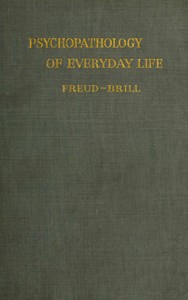
Psychopathology of Everyday Life
Written by Sigmund Freud
Chaptra reads alongside you — AI insights, chapter breakdowns and reader discussions for every book. Join free
About this book
Reading guide
Themes, characters and key ideas in Psychopathology of Everyday Life, written by Chaptra AI.
- about 10 hours
- advanced
- analytical
- insightful
- challenging
Sigmund Freud's "Psychopathology of Everyday Life" is a foundational psychoanalytic text that explores how seemingly trivial errors in daily life—such as forgetting names, slips of the tongue (Freudian slips), misplacing objects, or misreadings—are not random occurrences but are instead manifestations of unconscious thoughts, desires, and repressed conflicts. Through a meticulous examination of numerous anecdotes and personal observations, Freud argues for the psychological determinism of mental life, asserting that every mental act, even an error, has an underlying motivation. The book challenges the clear distinction between 'normal' and 'neurotic' behavior, demonstrating how unconscious drives operate universally and reveal the continuous interplay between conscious actions and hidden psychological forces. It posits that these 'pathologies' of everyday life offer a window into the dynamic workings of the human psyche and the mechanisms of repression.
“The forgetting of proper names is an exceedingly common and striking phenomenon.”
Key themes
- The Unconscious and Repression
- This is the central theme of the book. Freud argues that a significant portion of our mental life operates outside conscious awareness, influencing our thoughts, feelings, and actions. Repression is the mechanism by which unacceptable thoughts, desires, or memories are pushed into the unconscious, only to re-emerge in disguised forms, such as everyday errors. The book provides abundant evidence for the power and pervasive influence of these hidden mental processes.
- Psychological Determinism
- Freud posits that no mental act, however trivial or accidental it may seem, is truly arbitrary or random. Every thought, feeling, and action, including errors, is determined by preceding psychological causes, particularly unconscious motivations. This challenges the notion of absolute free will and suggests a deeper causality in mental life.
- Continuity Between Normal and Pathological
- Freud argues against a sharp dichotomy between 'normal' everyday behavior and 'pathological' neurotic symptoms. He demonstrates that the same psychological mechanisms—such as repression, conflict, and unconscious motivation—underlie both. Everyday errors are presented as mild, universal manifestations of these mechanisms, differing from neurotic symptoms primarily in their intensity and impact on the individual's life.
Worth discussing
To what extent do you agree with Freud's premise that nothing in our mental life is arbitrary or undetermined?
Chapter-by-chapter breakdowns, character arcs and the full thematic analysis come with a free account.
Discussions
No one has started one yet
Questions this book opens up
No discussions yet
Be the first to start a discussion about this book!
Sign up to start the discussionReviews
No reviews yet
Be the first to review this book!