
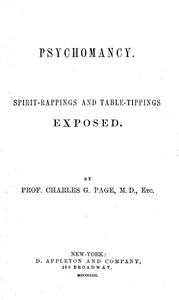
Psychomancy: Spirit-Rappings and Table-Tippings Exposed
Written by Charles Grafton Page
Chaptra reads alongside you — AI insights, chapter breakdowns and reader discussions for every book. Join free
About this book
Reading guide
Themes, characters and key ideas in Psychomancy: Spirit-Rappings and Table-Tippings Exposed, written by Chaptra AI.
- about 5 hours
- intermediate
- Skeptical
- Investigative
- Didactic
Charles Grafton Page's "Psychomancy: Spirit-Rappings and Table-Tippings Exposed" is a critical treatise from the mid-19th century that vehemently refutes the widespread phenomena of spiritualism. Page, through detailed accounts of his own investigations, asserts that spirit communications and table movements are not genuine supernatural occurrences but rather elaborate deceptions. He systematically exposes these practices as frauds perpetrated by charlatans, specifically targeting figures like the Fox sisters, who popularized spiritualism in America. The book serves as an impassioned call for critical thinking, urging readers to evaluate such claims through the lens of logic and scientific inquiry rather than succumbing to credulity.
“The true spirit of inquiry demands that we scrutinize all claims of the miraculous, lest we fall prey to the cunning of charlatans.”
Key themes
- Skepticism vs. Belief
- This is the central ideological conflict of the book. Page champions skepticism and rational inquiry, urging readers to question claims of the supernatural and demand empirical evidence. He contrasts this with the widespread, often uncritical, belief in spiritualism, which he attributes to human credulity and a desire for comfort in the face of loss or the unknown.
- Scientific Inquiry and Empirical Evidence
- Page positions his work as an exercise in scientific methodology. He emphasizes the importance of observation, experimentation, and logical deduction in understanding phenomena. He argues that only through rigorous investigation and the demand for reproducible results can truth be ascertained, contrasting this with the subjective and unverifiable nature of spiritualist claims.
- Deception and Human Gullibility
- A core theme is the ease with which people can be deceived, especially when driven by hope, grief, or a desire for the extraordinary. Page dissects the methods of charlatans like the Fox sisters, highlighting their manipulative tactics and the psychological vulnerabilities they exploited. He presents human gullibility not just as an individual failing but as a societal problem that allows fraud to flourish.
Worth discussing
How does Page's approach to debunking spiritualism reflect the scientific and intellectual climate of the mid-19th century?
Chapter-by-chapter breakdowns, character arcs and the full thematic analysis come with a free account.
Discussions
No one has started one yet
Questions this book opens up
No discussions yet
Be the first to start a discussion about this book!
Sign up to start the discussionReviews
No reviews yet
Be the first to review this book!