
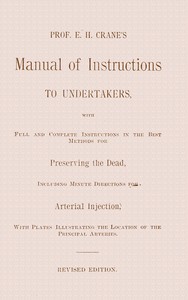
Prof. E. H. Crane's manual of instructions to undertakers : $b With full and complete instructions in the best methods for preserving the dead, including minute directions for arterial injection
Written by Elliott H. Crane
Chaptra reads alongside you — AI insights, chapter breakdowns and reader discussions for every book. Join free
About this book
Reading guide
Themes, characters and key ideas in Prof. E. H. Crane's manual of instructions to undertakers : $b With full and complete instructions in the best methods for preserving the dead, including minute directions for arterial injection, written by Chaptra AI.
- about 12 hours
- advanced
- instructive
- clinical
- historical
Prof. E. H. Crane's manual of instructions to undertakers is a foundational technical guide from the late 19th or early 20th century, meticulously detailing the then-current best practices for the preservation of human remains. It serves as a comprehensive textbook for undertakers, providing explicit, step-by-step instructions, particularly emphasizing arterial injection techniques for embalming. Beyond mere instruction, the manual reflects the professionalization of undertaking and the scientific advancements in post-mortem care during its era. It is a historical document offering profound insight into the evolving understanding of death, sanitation, and the rituals surrounding the deceased.
“The undertaker's sacred duty is to restore, as far as possible, the natural appearance, thereby offering solace to the grieving.”
Key themes
- The Professionalization of Undertaking
- The manual serves as a crucial artifact in the evolution of undertaking from a largely unregulated, often family-based trade to a recognized profession requiring specialized knowledge and skills. It emphasizes scientific methods, standardized procedures, and ethical conduct.
- Scientific Mastery Over Decay and Death
- At its core, the manual is an assertion of human ingenuity and scientific application against the natural process of decomposition. It reflects a growing confidence in chemistry and anatomy to control and mitigate the physical aspects of death, aiming for preservation and restoration.
- Public Health and Sanitation
- Published during a time of increased awareness of germ theory and public health, the manual implicitly and explicitly addresses the role of proper post-mortem care in preventing the spread of disease and ensuring public safety. Sanitation is presented as a fundamental component of the undertaker's duty.
Worth discussing
How did manuals like Crane's contribute to the professionalization and standardization of undertaking in the late 19th and early 20th centuries?
Chapter-by-chapter breakdowns, character arcs and the full thematic analysis come with a free account.
Discussions
No one has started one yet
Questions this book opens up
No discussions yet
Be the first to start a discussion about this book!
Sign up to start the discussionReviews
No reviews yet
Be the first to review this book!