
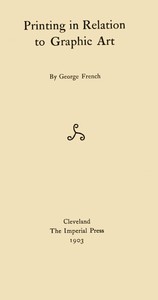
Printing in Relation to Graphic Art
Written by George French
Chaptra reads alongside you — AI insights, chapter breakdowns and reader discussions for every book. Join free
About this book
Reading guide
Themes, characters and key ideas in Printing in Relation to Graphic Art, written by Chaptra AI.
- about 8 hours
- advanced
- analytical
- informative
- didactic
George French's "Printing in Relation to Graphic Art" is a seminal early 20th-century work that meticulously dissects the inherent artistic potential within the utilitarian craft of printing. French argues for the thoughtful integration of aesthetic principles—such as typography, composition, and color—into mechanical printing processes, asserting that this balance elevates print design from mere reproduction to a true art form. The book systematically explores various components of print, emphasizing their historical significance and cultural impact, while advocating for a greater appreciation of printing's artistic dimensions. It posits that by adhering to established artistic tenets, printing can not only be functional but also profoundly educational and aesthetically pleasing, transforming its perception and practice.
“Printing, while primarily a utilitarian craft, possesses the inherent potential to elevate itself into an art form by adhering to time-honored artistic principles.”
Key themes
- The Elevation of Craft to Art
- This is the central theme, exploring how a utilitarian and mechanical craft like printing can transcend its functional purpose to become a legitimate art form through the conscious application of aesthetic principles. French argues that mere efficiency is insufficient; true mastery lies in combining technical skill with artistic sensibility, thereby imbuing printed works with beauty and deeper meaning.
- The Interconnection of Function and Aesthetics
- French meticulously demonstrates that in printing, function and aesthetics are not mutually exclusive but deeply intertwined. He posits that truly effective communication is enhanced, not hindered, by good design. An aesthetically pleasing design is often more readable, more impactful, and more memorable, thereby fulfilling its utilitarian purpose more effectively. This theme challenges the notion that art is purely decorative.
- Historical Context and Cultural Impact of Printing
- French frequently grounds his arguments in the historical trajectory of printing, from its origins as a revolutionary technology to its role in shaping public discourse and education. He emphasizes that understanding this history is crucial for appreciating printing's cultural significance and its potential as an art form. The book implicitly argues that a craft with such profound historical and cultural implications deserves artistic recognition.
Worth discussing
How does French's argument for printing as an art form resonate with contemporary digital design practices?
Chapter-by-chapter breakdowns, character arcs and the full thematic analysis come with a free account.
Discussions
No one has started one yet
Questions this book opens up
No discussions yet
Be the first to start a discussion about this book!
Sign up to start the discussionReviews
No reviews yet
Be the first to review this book!