
Chaptra

The AI reading companion for people who take books seriously

AI insights, chapter breakdowns, community discussions — all in one place.

Join free
Book0 • 300+ pages • 5+ hours reading time

Principia Ethica

3.3/5
209 readers on Chaptra have this book

About this book

"Principia Ethica" by G. E. Moore is a philosophical treatise written in the early 20th century. The work delves into the foundational questions of ethics, particularly focusing on the nature of good and the principles of ethical reasoning. It seeks to clarify essential ethical concepts and questions, distinguishing between what ought to exist for its own sake and what actions ought to be performed. At the start of "Principia Ethica," Moore establishes the premise that ethical confusion often arises from a lack of clarity about the questions being posed, arguing for the necessity of understanding what is meant by 'good' before attempting to define it. He distinguishes between two primary kinds of questions in ethics: those related to the intrinsic goodness of things and those concerning the rightness of actions. Moore contends that ethical propositions regarding what exists for its own sake are indefinable and presents the so-called 'naturalistic fallacy,' which critiques the conflation of moral terms with natural properties. He emphasizes the importance of this distinction as a foundation for serious ethical inquiry.
Language
English
Publisher
Project Gutenberg
Release date
Unknown
Downloads
949

More by G. E. (George Edward) Moore

Browse all books by this author
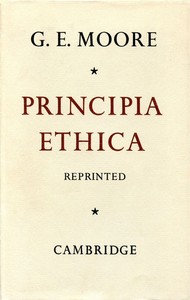
Cover of Principia Ethica

Click "Read now" to open in our Reader with AI features.

Community Discussions

Join the conversation about this book

Discussions

0 discussions

Join

No discussions yet

Be the first to start a discussion about this book!

Sign up to start the discussion

AI-Powered Insights

A clearer way to understand Principia Ethica through themes, characters, and key ideas

This reading guide highlights what stands out in Principia Ethica through 4 core themes. It is meant to help readers decide whether the book fits their taste and deepen the reading once they begin.

AI Reading GuidePreview

About this book

A quick AI guide to “Principia Ethica

Get the shape of the book before you commit: what it is about, what mood it carries, and what ideas readers tend to stay with afterward.

~12h readadvancedanalyticalrigorousfoundational

What the book is doing

G. E. Moore's "Principia Ethica" is a seminal work of early 20th-century analytical philosophy that fundamentally reshaped meta-ethics. Moore argues that the central concept of 'good' is simple, unanalyzable, and indefinable, akin to the color yellow. He introduces the influential 'naturalistic fallacy,' critiquing attempts to define 'good' in terms of natural properties (like 'pleasant' or 'desired') or metaphysical properties, asserting that such definitions confuse the property itself with something that merely possesses it. The book meticulously distinguishes between questions of intrinsic value (what is good for its own sake) and questions of conduct (what actions are right), laying the groundwork for a rigorous, non-naturalistic approach to ethical inquiry. Ultimately, Moore concludes that the highest intrinsic goods are personal affection and aesthetic enjoyment, offering a positive ethical vision grounded in his meta-ethical foundations.

Key Themes

The Indefinability of 'Good'

Moore's central thesis is that 'good' is a simple, unanalyzable, non-natural property that cannot be defined in terms of any other concept. He argues that any attempt to define 'good' reduces it to something else, missing its unique moral quality. This is supported by his 'open-question argument,' which posits that for any proposed definition X of 'good,' it always remains an open and meaningful question whether 'Is X good?'

The Naturalistic Fallacy

This is the most famous concept introduced by Moore. The naturalistic fallacy is the error of attempting to define the non-natural property 'good' in terms of some natural property (e.g., pleasure, desire, happiness, evolutionary fitness) or a metaphysical property. Moore argues that such definitions confuse the property 'good' itself with something that merely *has* that property, thereby failing to grasp the unique meaning of 'good'.

A line worth noting
If I am asked 'What is good?', my answer is that good is good, and that is the end of the matter. Or if I am asked 'How is good to be defined?', my answer is that it cannot be defined, and that is all I have to say about it.
A good discussion starter

Is 'good' truly indefinable, as Moore argues, or can it be defined in naturalistic terms without committing a fallacy?

Unlock the full reading guide

See chapter-by-chapter takeaways, deeper character arcs, and a fuller literary analysis built around this book.

Unlock full AI analysis for “Principia Ethica

Chapter breakdowns, character deep-dives, and thematic analysis — all in one place.

Reader Reviews

See what others are saying

Reviews

Overall Rating

3.3
1815 ratings

Based on community ratings

No reviews yet

Be the first to review this book!

Readers Also Enjoyed

Discover more books similar to Principia Ethica