
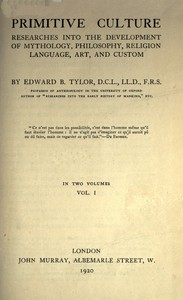
Primitive culture, vol. 1 (of 2) : $b Researches into the development of mythology, philosophy, religion, language, art, and custom
Written by Edward B. (Edward Burnett) Tylor
Chaptra reads alongside you — AI insights, chapter breakdowns and reader discussions for every book. Join free
About this book
Reading guide
Themes, characters and key ideas in Primitive culture, vol. 1 (of 2) : $b Researches into the development of mythology, philosophy, religion, language, art, and custom, written by Chaptra AI.
- about 35 hours
- advanced
- academic
- analytical
- historical
Edward B. Tylor's "Primitive Culture, vol. 1" is a foundational text in anthropology, published in the late 19th century, that systematically explores the development of human culture. Tylor defines culture broadly as a complex whole encompassing knowledge, belief, art, morals, law, custom, and any other capabilities and habits acquired by man as a member of society. He argues for a uniformitarian view of cultural evolution, suggesting that all societies progress through similar stages from 'primitive' to 'civilized,' driven by natural laws rather than supernatural intervention. The work extensively uses ethnographic data to trace the origins and development of various cultural phenomena, most notably introducing the concept of 'animism' as the earliest form of religion, thereby laying much of the groundwork for modern cultural anthropology.
“Culture, or civilization, taken in its wide ethnographic sense, is that complex whole which includes knowledge, belief, art, morals, law, custom, and any other capabilities and habits acquired by man as a member of society.”
Key themes
- Cultural Evolutionism
- This is the central organizing principle of Tylor's work. He posits that all human societies progress through fixed, sequential stages of development (e.g., savagery, barbarism, civilization). This theme attempts to provide a universal framework for understanding cultural change, suggesting a natural, law-governed progression from simpler to more complex forms across all cultural domains.
- The Origins of Religion (Animism)
- Tylor's most famous contribution, animism, is presented as the foundational religious concept. He theorizes that early humans, attempting to explain phenomena like dreams, trances, and death, developed the idea of a separable soul or spirit. This belief in spiritual beings then expanded to encompass spirits inhabiting natural objects and ultimately led to more complex religious systems.
- Psychic Unity of Mankind
- Tylor argues that, despite superficial differences, all human minds share fundamental cognitive structures and processes. This means that people in different societies, when faced with similar circumstances, will tend to develop similar ideas, beliefs, and institutions. This theme provides the underlying rationale for his comparative method and the universality of cultural evolution.
Worth discussing
How does Tylor's definition of 'culture' compare with modern anthropological definitions? What are the key differences and enduring similarities?
Chapter-by-chapter breakdowns, character arcs and the full thematic analysis come with a free account.
Discussions
No one has started one yet
Questions this book opens up
No discussions yet
Be the first to start a discussion about this book!
Sign up to start the discussionReviews
No reviews yet
Be the first to review this book!