
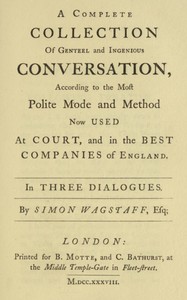
Polite Conversation in Three Dialogues
Written by Jonathan Swift
Chaptra reads alongside you — AI insights, chapter breakdowns and reader discussions for every book. Join free
About this book
Reading guide
Themes, characters and key ideas in Polite Conversation in Three Dialogues, written by Chaptra AI.
- about 6 hours
- intermediate
- humorous
- satirical
- witty
Jonathan Swift's "Polite Conversation in Three Dialogues" is an early 18th-century satirical masterpiece that meticulously dissects the superficiality and banality of English upper-class social discourse. Through a series of three dialogues, Swift presents a cast of archetypal characters, including Lady Smart, Lord Sparkish, Colonel Atwit, and Mr. Neverout, who engage in exchanges full of clichés, empty pleasantries, and borrowed wit. The work functions as a humorous, albeit biting, critique of the era's obsession with artificial politeness and conversational etiquette, revealing the underlying intellectual poverty. It brilliantly captures the social nuances and linguistic habits of its time, offering an enduring commentary on human pretension and the performance of social status.
“"Pray, madam, how do you do?"”
Key themes
- Satire of Social Manners and Politeness
- This is the overarching theme of the work. Swift meticulously satirizes the artificiality, superficiality, and rigid conventions that governed polite society in 18th-century England. He exposes how genuine interaction and intellectual substance were often sacrificed for the sake of conforming to prescribed social rituals and empty pleasantries.
- The Nature and Misuse of Language
- Swift uses the dialogues to explore and critique the degradation of language. He demonstrates how language, meant for communication and expression, can be reduced to a collection of meaningless sounds and pre-fabricated phrases when originality and thought are absent. The book serves as a linguistic manual for 'bad' conversation.
- Hypocrisy and Artificiality
- Underlying the 'polite' facade of the conversations is a pervasive sense of hypocrisy and artificiality. Swift reveals how the characters are performing roles rather than engaging authentically, prioritizing appearances and social acceptance over sincerity or truth. Their interactions are a theatrical display of manners.
Worth discussing
How does Swift use satire to critique 18th-century social manners and what elements of this critique remain relevant today?
Chapter-by-chapter breakdowns, character arcs and the full thematic analysis come with a free account.
Discussions
No one has started one yet
Questions this book opens up
No discussions yet
Be the first to start a discussion about this book!
Sign up to start the discussionReviews
No reviews yet
Be the first to review this book!