
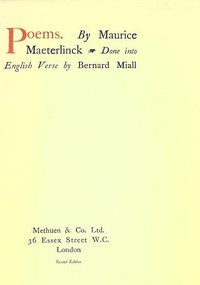
Poems
Written by Maurice Maeterlinck
Chaptra reads alongside you — AI insights, chapter breakdowns and reader discussions for every book. Join free
About this book
Reading guide
Themes, characters and key ideas in Poems, written by Chaptra AI.
- about 8 hours
- advanced
- melancholic
- introspective
- haunting
Maurice Maeterlinck's "Poems," translated by Bernard Miall in 1915, is a seminal collection deeply rooted in the Belgian Symbolist movement. It profoundly explores themes of isolation, existential longing, and the intricate human experience through a lens of melancholic beauty and introspective thought. Maeterlinck employs rich, evocative imagery, such as hot-houses and diving bells, to symbolize the soul's confinement and its yearning for liberation. The collection invites readers into a world of nuanced emotions and mental states, characterized by a unique poetic voice that navigates the interplay of light and darkness, memory's weight, and the search for meaning amidst life's complexities.
Key themes
- Isolation and Confinement
- This theme is central to Maeterlinck's poetry, exploring the inherent solitude of the human experience. The poems frequently depict the soul as enclosed or separated, struggling against boundaries both literal and metaphorical. This isolation is not always negative; it can also be a space for profound introspection, though often tinged with melancholia.
- Existential Longing and Search for Meaning
- Maeterlinck's poems are imbued with a deep sense of yearning for something beyond the tangible—be it understanding, connection, or liberation from existential angst. This longing often manifests as an unspoken desire for transcendence or a clearer grasp of life's purpose amidst its inherent complexities and uncertainties.
- The Interplay of Light and Darkness
- Light and darkness are not merely descriptive elements but profound symbolic forces in Maeterlinck's poetry. They represent the constant tension between knowledge and ignorance, hope and despair, clarity and obscurity, and the visible versus the hidden aspects of the human soul and the universe.
Worth discussing
How do Maeterlinck's metaphors (e.g., hot-houses, diving bells) illuminate the concept of human consciousness and its limitations?
Chapter-by-chapter breakdowns, character arcs and the full thematic analysis come with a free account.
Discussions
No one has started one yet
Questions this book opens up
No discussions yet
Be the first to start a discussion about this book!
Sign up to start the discussionReviews
No reviews yet
Be the first to review this book!