
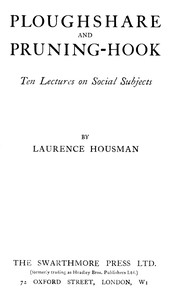
Ploughshare and Pruning-Hook: Ten Lectures on Social Subjects
Written by Laurence Housman
Chaptra reads alongside you — AI insights, chapter breakdowns and reader discussions for every book. Join free
About this book
Reading guide
Themes, characters and key ideas in Ploughshare and Pruning-Hook: Ten Lectures on Social Subjects, written by Chaptra AI.
- about 8 hours
- advanced
- Thought-provoking
- Idealistic
- Critical
Laurence Housman's "Ploughshare and Pruning-Hook: Ten Lectures on Social Subjects" is a collection of early 20th-century essays advocating for profound moral and spiritual transformation within society. Housman argues that genuine social reform hinges on individuals and institutions alike confronting their moral failings and embracing self-accusation rather than defensiveness. He critiques the inherent complacency and vice perpetuated by political systems and state institutions, highlighting a significant disparity in accountability compared to religious spheres. The book passionately calls for a fundamental shift in societal values, urging a pursuit of righteousness that addresses underlying moral decay rather than merely superficial symptoms.
“"The greatest reform must begin not with the pruning-hook of external coercion, but with the ploughshare of individual self-accusation."”
Key themes
- Individual and Institutional Morality/Accountability
- This is the central pillar of Housman's argument. He posits that societal problems are rooted not just in flawed systems, but in the moral failings of the individuals who comprise and lead them. Crucially, he extends this to institutions, arguing that they too must be capable of 'self-accusation' and honest acknowledgment of error, rather than defensive posturing. This theme explores the ethical responsibilities at both micro and macro levels.
- Social Reform and Idealism
- Housman's work is imbued with a strong, idealistic vision for social change. He believes that true reform goes beyond superficial adjustments to laws or policies; it requires a fundamental 'change of heart' within society. This theme explores the power and necessity of idealism in driving transformative social movements, emphasizing moral and spiritual renewal as prerequisites for a better society.
- Critique of Political Systems and Moral Complacency
- Housman launches a pointed critique against the inherent moral complacency and defensive nature of political systems. He argues that these systems often perpetuate societal vice rather than virtue because they prioritize self-preservation and expediency over genuine ethical conduct. This theme examines how political structures can hinder moral progress and the mechanisms by which accountability is often sidestepped.
Worth discussing
To what extent is Housman's call for individual 'self-accusation' a practical foundation for societal change?
Chapter-by-chapter breakdowns, character arcs and the full thematic analysis come with a free account.
Discussions
No one has started one yet
Questions this book opens up
No discussions yet
Be the first to start a discussion about this book!
Sign up to start the discussionReviews
No reviews yet
Be the first to review this book!