
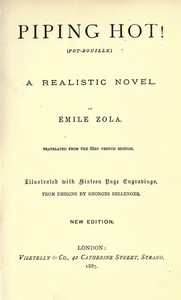
Piping hot! (Pot-bouille) : $b a realistic novel
Written by Émile Zola
Chaptra reads alongside you — AI insights, chapter breakdowns and reader discussions for every book. Join free
About this book
Reading guide
Themes, characters and key ideas in Piping hot! (Pot-bouille) : $b a realistic novel, written by Chaptra AI.
- about 15 hours
- advanced
- dark
- satirical
- bleak
Émile Zola's "Piping Hot!" (Pot-bouille) offers a scathing, naturalistic exposé of bourgeois hypocrisy and moral decay in late 19th-century Paris. The novel follows Octave Mouret, an ambitious young man, as he arrives in the city and becomes entangled in the complex, often scandalous lives of the residents in a seemingly respectable apartment building. Through a series of adulterous affairs, social maneuvering, and domestic dramas, Zola strips away the veneer of middle-class respectability, revealing a festering 'stew' of lust, ambition, and corruption beneath. It critiques the institution of marriage, the pursuit of social status, and the pervasive moral emptiness that defines the era's Parisian bourgeoisie. The narrative ultimately portrays a cycle of relentless self-interest and deceit, where genuine affection is sacrificed for appearances and material gain.
“"The house, like a huge stew-pot, was constantly boiling with the ignoble passions, the sordid calculations, the hidden lusts of its inhabitants."”
Key themes
- Bourgeois Hypocrisy and Moral Decay
- This is the central theme of 'Pot-bouille.' Zola meticulously exposes the vast chasm between the outward appearance of respectability, piety, and virtue maintained by the Parisian middle class and their private lives, which are rife with adultery, lust, greed, and manipulation. The apartment building itself acts as a metaphor for this facade, with elegant exteriors concealing a 'stew' of moral corruption within.
- The Destructive Nature of Desire and Sexual Frustration
- Zola portrays desire, particularly sexual desire, as a powerful, often uncontrollable force that drives many characters' actions and leads to their downfall. Suppressed by societal norms and hypocritical morality, these desires manifest in destructive ways, leading to infidelity, scandal, and personal ruin. The novel explores how both repression and indulgence of desire can be equally ruinous.
- Social Climbing and Materialism
- The novel critically examines the pervasive obsession with social status and material wealth within the bourgeois class. Characters are constantly striving to improve their position, often through morally dubious means like advantageous marriages, financial manipulation, and the cultivation of influential connections. This pursuit of status overrides genuine human connection and ethical considerations.
Worth discussing
How does Zola use the apartment building as a character or a metaphor for Parisian society? What does 'pot-bouille' truly signify?
Chapter-by-chapter breakdowns, character arcs and the full thematic analysis come with a free account.
Discussions
No one has started one yet
Questions this book opens up
No discussions yet
Be the first to start a discussion about this book!
Sign up to start the discussionReviews
No reviews yet
Be the first to review this book!