
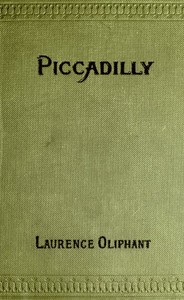
Piccadilly: A Fragment of Contemporary Biography
Written by Laurence Oliphant
Chaptra reads alongside you — AI insights, chapter breakdowns and reader discussions for every book. Join free
About this book
Read it with a club
Small groups reading the same books and talking as they go.


News
- 4 members
- 1,813 discussions
- Active Sep 11
Read Piccadilly: A Fragment of Contemporary Biography alongside people who are reading it too.
Also here: News Bulletin, Just Joking....
Chaptra Prime — paid clubs, every club feature, and unlimited reading support, for $5 a month or $60 once.
See PrimeReading guide
Themes, characters and key ideas in Piccadilly: A Fragment of Contemporary Biography, written by Chaptra AI.
- about 8 hours
- intermediate
- humorous
- satirical
- observational
Laurence Oliphant's "Piccadilly: A Fragment of Contemporary Biography" is a late 19th-century satirical novel that skewers the social conventions and moral dilemmas of Victorian London through the eyes of its protagonist, Frank Vanecourt. Newly settled in Piccadilly, Vanecourt, a disillusioned observer, initially intends to pen a grand history of civilization but is humorously diverted by the witty Lady Veriphast to focus on his own personal experiences. The narrative follows Frank's encounters with fashionable society, blending comedic observations with sharp critiques of societal follies and the complexities of human relationships, particularly love. It serves as both a lighthearted social commentary and a deeper exploration of the individual's place within a seemingly absurd yet alluring world.
“"Civilization, my dear Grandon, is a malady of the soul, and I intend to write its history from the vantage point of its most virulent symptoms."”
Key themes
- Satire of Social Conventionalism
- The novel critically examines and ridicules the rigid social norms, expectations, and hypocrisies prevalent in late 19th-century London society. It highlights the often-absurd rules governing behavior, marriage, and reputation, contrasting them with genuine human emotions and desires.
- The Nature of Love and Relationships
- The novel explores the complexities and challenges of romantic love within a society dictated by social conventions. It delves into the tension between genuine affection, societal expectations (e.g., marriage for status or wealth), and the emotional dilemmas faced by characters.
- Individual vs. Society
- This theme examines the conflict between an individual's personal ideals, intellectual pursuits, and moral compass against the demands and influences of the broader society. Frank Vanecourt's journey is central to this, as he attempts to maintain his critical perspective while being drawn into the very society he critiques.
Worth discussing
How does Frank Vanecourt's initial cynicism about civilization evolve throughout the narrative, and what causes these shifts?
Chapter-by-chapter breakdowns, character arcs and the full thematic analysis come with a free account.
Discussions
No one has started one yet
Questions this book opens up
No discussions yet
Be the first to start a discussion about this book!
Sign up to start the discussionReviews
No reviews yet
Be the first to review this book!