
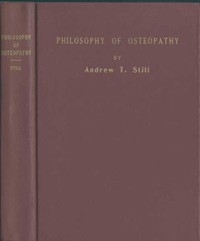
Philosophy of Osteopathy
Written by A. T. (Andrew Taylor) Still
Chaptra reads alongside you — AI insights, chapter breakdowns and reader discussions for every book. Join free
About this book
Read it with a club
Small groups reading the same books and talking as they go.


News
- 4 members
- 1,813 discussions
- Active Sep 11
Read Philosophy of Osteopathy alongside people who are reading it too.
Also here: News Bulletin, Just Joking....
Chaptra Prime — paid clubs, every club feature, and unlimited reading support, for $5 a month or $60 once.
See PrimeReading guide
Themes, characters and key ideas in Philosophy of Osteopathy, written by Chaptra AI.
- about 10 hours
- advanced
- instructive
- foundational
- challenging
A. T. Still's "Philosophy of Osteopathy" lays the foundational principles for a new medical science that rejects traditional drug-based approaches. Written in the late 19th century, the book emphasizes a deep understanding of anatomy and the body's inherent self-healing capabilities as central to health and disease. Still critiques conventional medicine, advocating for a holistic view that sees the body as an interconnected system capable of maintaining and restoring its own health. The text serves as a comprehensive framework, rooted in the author's personal journey of discovery, to establish osteopathy as a distinct and effective therapeutic philosophy. It urges practitioners to cultivate an 'artistic view' of the human form, understanding the intricate relationships between structure and function.
“The body is a machine, a grand machine, and it must be understood as such.”
Key themes
- The Body's Innate Healing and Self-Regulation
- This is a cornerstone of Still's philosophy. He posits that the human body possesses an inherent capacity to heal itself and maintain its own health, provided there are no obstructions or dysfunctions. The role of the osteopath is not to 'cure' but to remove impediments to the body's natural healing processes, allowing health to express itself. This challenges the prevailing medical view that external agents (drugs) are the primary means of restoring health.
- Primacy of Anatomy and Structure-Function Relationship
- Still relentlessly emphasizes that a profound and detailed understanding of human anatomy is absolutely essential for any effective medical practice. He argues that structure (anatomy) dictates function (physiology), and that any deviation or abnormality in structure will inevitably lead to altered or compromised function, resulting in disease. This theme calls for an 'artistic' appreciation of the body's intricate design and interconnections.
- Holism and the Unity of the Body
- Still champions the idea that the human body functions as an integrated, indivisible unit, not as a collection of separate parts or systems. He argues that a problem in one area of the body can and often does affect the entire organism. This holistic perspective necessitates a comprehensive approach to diagnosis and treatment, considering all aspects of the patient rather than focusing solely on isolated symptoms.
Worth discussing
How does Still's critique of 19th-century medicine compare to modern criticisms of healthcare systems?
Chapter-by-chapter breakdowns, character arcs and the full thematic analysis come with a free account.
Discussions
No one has started one yet
Questions this book opens up
No discussions yet
Be the first to start a discussion about this book!
Sign up to start the discussionReviews
No reviews yet
Be the first to review this book!