
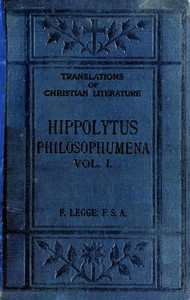
Philosophumena; or, The refutation of all heresies, Volume I
Written by Antipope Hippolytus
Chaptra reads alongside you — AI insights, chapter breakdowns and reader discussions for every book. Join free
About this book
Reading guide
Themes, characters and key ideas in Philosophumena; or, The refutation of all heresies, Volume I, written by Chaptra AI.
- about 15 hours
- advanced
- analytical
- polemical
- scholarly
Philosophumena, Volume I, by Antipope Hippolytus, is a foundational early Christian polemic from the 3rd century AD, initiating a systematic refutation of various heresies. Hippolytus embarks on an ambitious project to expose the philosophical roots of these heterodox beliefs, arguing that many Christian heresies, particularly Gnosticism, derive from ancient Greek philosophical traditions rather than divine revelation. This initial volume sets the stage by outlining its methodological approach and then delving into the foundational ideas of pre-Socratic thinkers like Thales, Pythagoras, and Empedocles. Through this historical and philosophical genealogy, Hippolytus aims to discredit heretical thought by demonstrating its pagan intellectual lineage, thereby defending the purity and distinctiveness of orthodox Christian doctrine.
“"For the purpose of our undertaking is not to set forth the doctrines of the philosophers, but to expose the heresies, and to show that they are derived from these very philosophers."”
Key themes
- The Origins of Heresy
- This is the central thesis of Volume I. Hippolytus argues that Christian heresies do not arise from new divine revelations but are rather corruptions derived from ancient Greek philosophical traditions. He meticulously traces the intellectual lineage of various heterodox beliefs back to the doctrines of figures like Thales, Pythagoras, and Empedocles, aiming to discredit them by demonstrating their 'pagan' roots.
- Orthodoxy vs. Heterodoxy
- The entire work is framed as a defense of orthodox Christian belief against the perceived errors of heretical doctrines. Hippolytus's mission is to clearly demarcate the boundaries of acceptable Christian thought, defining what constitutes true faith in opposition to what he identifies as false teachings. This theme explores the struggle for doctrinal clarity and authority in the early Church.
- The Role of Greek Philosophy in Christian Thought
- Hippolytus engages deeply with Greek philosophy, not to embrace it, but to critique its influence on Christian thought. This theme explores the complex and often contentious relationship between Hellenistic intellectual traditions and the burgeoning Christian faith. Hippolytus argues that philosophy, while offering intellectual tools, becomes a source of error when it supersedes or distorts divine revelation.
Worth discussing
How does Hippolytus's methodology of tracing heresies to Greek philosophy shape his argument, and what are its strengths and weaknesses?
Chapter-by-chapter breakdowns, character arcs and the full thematic analysis come with a free account.
Discussions
No one has started one yet
Questions this book opens up
No discussions yet
Be the first to start a discussion about this book!
Sign up to start the discussionReviews
No reviews yet
Be the first to review this book!