
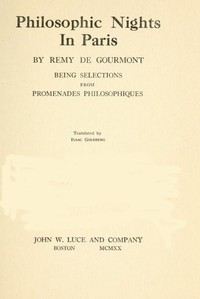
Philosophic Nights in Paris: Being selections from Promenades Philosophiques
Written by Remy de Gourmont
Chaptra reads alongside you — AI insights, chapter breakdowns and reader discussions for every book. Join free
About this book
Reading guide
Themes, characters and key ideas in Philosophic Nights in Paris: Being selections from Promenades Philosophiques, written by Chaptra AI.
- about 12 hours
- advanced
- Contemplative
- Philosophical
- Introspective
Remy de Gourmont's "Philosophic Nights in Paris" is a captivating collection of early 20th-century philosophical essays, offering profound reflections on fundamental aspects of human existence. As a prominent figure in the Symbolist movement, de Gourmont masterfully intertwines literary artistry with deep philosophical inquiry, exploring themes such as the pursuit of happiness, the intricacies of free will, the essence of existence, and the profound impact of perception on reality. The work serves as an intellectual promenade through the author's contemplative world, beginning with an introduction to his unique Symbolist perspective and then delving into a rich tapestry of avant-garde thought. It provides readers with both a window into the human condition and a critical lens on the complexities of modern life, all presented with a distinctive stylistic flair.
“Happiness is not a state to be achieved, but a perception to be cultivated, a fleeting dance between desire and acceptance.”
Key themes
- Perception and Reality
- A cornerstone of Gourmont's philosophy, this theme asserts that reality is not an objective, universally agreed-upon entity, but rather a subjective construct filtered and interpreted through individual perception. He emphasizes that what we experience as 'real' is heavily influenced by our senses, consciousness, and personal biases, making the inner world as significant, if not more so, than the external one.
- The Nature of Happiness
- Gourmont extensively explores the concept of happiness, challenging conventional notions. He suggests that happiness is not a fixed state or an external achievement, but rather a subjective and often fleeting perception, deeply intertwined with individual consciousness and the acceptance of life's inherent complexities. He delves into the psychological and existential aspects of seeking contentment.
- Symbolism and Artistic Expression
- As a key interpreter of the Symbolist movement, Gourmont's essays inherently embody and reflect its principles. This theme explores how art, particularly Symbolist art, serves as a means to express the ineffable, to suggest rather than state, and to delve into the subjective, often mystical, dimensions of human experience. He sees artistic expression not just as aesthetics but as a profound philosophical tool for understanding reality.
Worth discussing
How does Gourmont's Symbolist background influence his approach to philosophical inquiry?
Chapter-by-chapter breakdowns, character arcs and the full thematic analysis come with a free account.
Discussions
No one has started one yet
Questions this book opens up
No discussions yet
Be the first to start a discussion about this book!
Sign up to start the discussionReviews
No reviews yet
Be the first to review this book!