
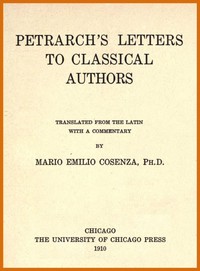
Petrarch's Letters to Classical Authors
Written by Francesco Petrarca
Chaptra reads alongside you — AI insights, chapter breakdowns and reader discussions for every book. Join free
About this book
Reading guide
Themes, characters and key ideas in Petrarch's Letters to Classical Authors, written by Chaptra AI.
- about 8 hours
- advanced
- reflective
- intellectual
- critical
Petrarch's Letters to Classical Authors is a seminal 14th-century collection where Francesco Petrarca engages in a profound, imagined correspondence with revered ancient figures like Cicero, Seneca, and Vergil. This work serves as a pivotal bridge between the classical and Renaissance worlds, showcasing Petrarch's deep admiration for ancient wisdom alongside a critical examination of his heroes' moral choices and public lives. Through these introspective letters, Petrarch explores themes of humanism, virtue, legacy, and the role of the intellectual, simultaneously lamenting the perceived decline of his own era. The collection's unique epistolary structure allows Petrarch to fashion his own identity as a leading humanist, reflecting on timeless philosophical questions and the enduring power of dialogue across centuries.
“I have addressed myself to you as if you were truly present, for the very discovery of your letters has made you seem so.”
Key themes
- Humanism and the Revival of Antiquity
- This is the foundational theme. Petrarch's letters are a direct manifestation of early humanism, emphasizing the study of classical antiquity not merely for knowledge but for moral and intellectual guidance. He seeks to revive the literary styles, philosophical insights, and civic virtues of the classical world, believing they hold the key to societal improvement and individual flourishing. The act of writing to these authors directly embodies this revival.
- Moral Philosophy and the Pursuit of Virtue
- Petrarch is deeply concerned with ethics and the moral conduct of individuals, particularly intellectuals and public figures. He uses the lives of his classical heroes as case studies, praising their virtues (e.g., Seneca's Stoicism) while critiquing their moral failings or questionable choices (e.g., Cicero's political ambition). This theme underscores Petrarch's belief that intellectual pursuits must be aligned with ethical living.
- Dialogue Across Eras and the Timelessness of Ideas
- The very premise of the book—writing letters to deceased authors—underscores the belief that intellectual and moral dialogue transcends time. Petrarch asserts the enduring relevance of classical thought and demonstrates that ideas and ethical dilemmas are not confined to their historical periods but resonate across centuries, allowing for a continuous conversation between past and present.
Worth discussing
How does Petrarch's act of writing to classical authors challenge or reinforce our understanding of historical distance?
Chapter-by-chapter breakdowns, character arcs and the full thematic analysis come with a free account.
Discussions
No one has started one yet
Questions this book opens up
No discussions yet
Be the first to start a discussion about this book!
Sign up to start the discussionReviews
No reviews yet
Be the first to review this book!