
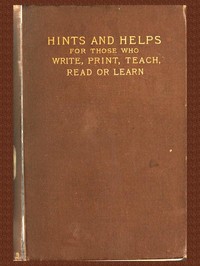
Pens and Types: or Hints and Helps for Those who Write, Print, Read, Teach, or Learn
Written by Benjamin Drew
Chaptra reads alongside you — AI insights, chapter breakdowns and reader discussions for every book. Join free
About this book
Reading guide
Themes, characters and key ideas in Pens and Types: or Hints and Helps for Those who Write, Print, Read, Teach, or Learn, written by Chaptra AI.
- about 10 hours
- intermediate
- instructive
- practical
- informative
Benjamin Drew's "Pens and Types" is a seminal late 19th-century practical guide offering comprehensive advice for anyone involved in the creation, production, or instruction of written English. Emphasizing clarity and precision, the book meticulously covers essential topics such as proofreading, punctuation, orthography, and capitalization, aiming to elevate standards in writing, printing, and teaching. Drew masterfully illustrates the critical importance of legible and accurate communication through humorous examples of misprints, underscoring how carelessness can lead to significant misunderstandings. This work serves as both a manual for aspiring professionals and a foundational text for language educators, highlighting the profound interconnectedness of reading and writing proficiency for effective communication in the burgeoning print era.
“"The greatest fault in writing is illegibility; for what cannot be read, cannot be understood."”
Key themes
- Clarity and Legibility in Communication
- This is the foundational theme of the book. Drew argues that effective communication hinges entirely on the clarity and legibility of written material. He demonstrates how ambiguity, poor handwriting, or grammatical errors can lead to serious misunderstandings, wasted effort, and even humorous but impactful misinterpretations, making this a practical necessity for societal interaction and commerce.
- Professionalism in Printing and Publishing
- Drew's guide implicitly champions a high standard of professionalism within the burgeoning late 19th-century publishing industry. By providing rigorous rules for proofreading, punctuation, and orthography, he advocates for meticulous attention to detail and a commitment to accuracy as essential components of a credible and respected press. This theme underscores the responsibility of all involved in the dissemination of written content.
- The Interconnectedness of Language Skills
- The book highlights that writing, reading, and teaching are not isolated skills but are deeply interdependent. Drew addresses writers to improve their output, printers to ensure accurate reproduction, and educators to instill proper language use, thereby creating a symbiotic relationship where proficiency in one area enhances the others. Effective teaching relies on clear writing, which in turn facilitates better reading and understanding.
Worth discussing
How do Drew's arguments for clarity and legibility in the late 19th century translate to digital communication today?
Chapter-by-chapter breakdowns, character arcs and the full thematic analysis come with a free account.
Discussions
No one has started one yet
Questions this book opens up
No discussions yet
Be the first to start a discussion about this book!
Sign up to start the discussionReviews
No reviews yet
Be the first to review this book!