
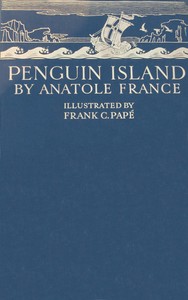
Penguin Island
Written by Anatole France
Chaptra reads alongside you — AI insights, chapter breakdowns and reader discussions for every book. Join free
About this book
Reading guide
Themes, characters and key ideas in Penguin Island, written by Chaptra AI.
- about 12 hours
- advanced
- satirical
- philosophical
- witty
Anatole France's "Penguin Island" is a biting satirical novel recounting the fantastical history of a nation of penguins, mistakenly baptized as humans by the myopic Saint Maël. This initial blunder sets in motion a sprawling narrative that parodies human civilization from its primitive origins through various historical epochs, including the Middle Ages, the Renaissance, and modern industrial society. Through the lens of anthropomorphic penguins, France dissects and lampoons religious dogma, political systems, social conventions, and the inherent follies of human nature. The novel ultimately presents a cyclical view of history, suggesting that humanity is destined to repeat its mistakes, culminating in an apocalyptic vision of societal collapse and rebirth.
“It is not by reasoning that one is led to believe, but by believing that one is led to reason.”
Key themes
- Satire of Religion and Dogma
- The entire premise of the novel—the mistaken baptism of penguins and the subsequent theological debate—is a direct satire of religious dogma and the arbitrary nature of doctrine. France critiques the Church's bureaucracy, its historical role in political power, the hypocrisy of its leaders, and the blind faith of its adherents.
- Critique of Political Systems and History
- France systematically parodies various political structures and historical events, from the primitive formation of property laws to feudalism, monarchy, republicanism, and modern industrial states. He highlights the inherent flaws in governance, the corruption of power, the cyclical nature of revolutions, and the often-absurd justifications for war and social inequality.
- Human Nature and Civilization
- The novel suggests that despite technological and social advancements, fundamental human flaws—greed, vanity, superstition, aggression, and irrationality—remain constant. Civilization is presented as a thin veneer over these base instincts, often exacerbating rather than mitigating them. The penguins, even with souls, demonstrate all the follies of humanity.
Worth discussing
How does France's portrayal of the penguins' transformation into humans satirize the concept of human nature and civilization?
Chapter-by-chapter breakdowns, character arcs and the full thematic analysis come with a free account.
Discussions
No one has started one yet
Questions this book opens up
No discussions yet
Be the first to start a discussion about this book!
Sign up to start the discussionReviews
No reviews yet
Be the first to review this book!